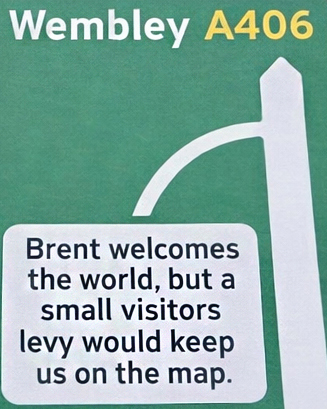
 Harrow should back Brent Council’s call (photo from their campaign) for any overnight Visitor Levy to be rooted in fiscal fairness and meaningful local retention. What happens in Brent has clear consequences for Harrow, as the effects of major events at Wembley extend well beyond administrative boundaries. The Government’s Overnight Visitor Levy consultation is therefore significant for both boroughs, and its framework must reflect the true geography of impact.
As home to Wembley Stadium and the OVO Arena, Brent attracts millions of people each year for high-profile sporting, cultural and entertainment events. While the economic and reputational gains are often described at a London-wide or national level, the operational burden is concentrated locally and frequently felt in neighbouring communities.
Event-day pressures spill into Harrow in practical ways. Accommodation demand spreads across borough lines; traffic and parking displacement affect residential streets; public transport hubs such as Stanmore station experience heavy crowd movement; and additional policing and environmental management are required. Hotels and short-term lets outside Brent absorb overnight stays, while surrounding town centres and road networks contend with intensified use. For Harrow residents, these impacts are visible and immediate.
The proposed overnight Visitor Levy, a charge on short-stay accommodation, is intended to help authorities manage the costs associated with high visitor volumes. Brent has argued that at least half of any revenue should remain in host areas, that allocations should correspond to visitor numbers, and that a percentage-based structure would maintain proportionality over time.
Major events create sustained demands on cleansing, waste services, transport coordination, public safety and maintenance of the public realm. These are measurable financial pressures. The central issue is whether the levy’s design will recognise cross-border consequences. If proceeds are retained solely according to accommodation location, neighbouring boroughs facing secondary strain may receive little support. A distribution model aligned to visitor flows and evidenced service demand would deliver a more equitable outcome.
As consultation continues, the final structure will determine whether areas adjacent to world-scale venues receive funding that matches lived reality. For Harrow, this is not abstract policy; it is a question of fairness and local impact.
HMG Submission to Government Consultation on the Introduction of a Mayoral Power to Create Overnight Visitor Levies
- Comment
- Reblog
-
Subscribe
Subscribed
Already have a WordPress.com account? Log in now.
 Harrow Monitoring Group