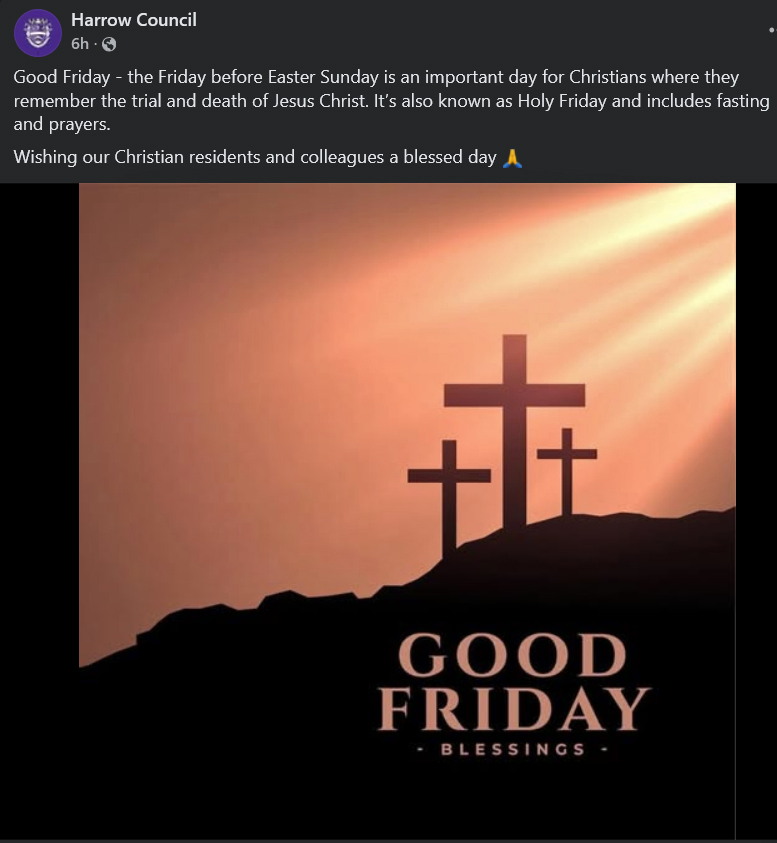
Harrow Council is facing criticism over its latest Good Friday message, with critics arguing that the wording reflects a calculated attempt to appeal to Christian voters while sidestepping the theological and historical weight of the occasion.
The message, which states that “Good Friday – the Friday before Easter Sunday is an important day for Christians where they remember the trial and death of Jesus Christ,” has drawn scrutiny for what some see as an overly cautious and reductive portrayal of one of Christianity’s most significant events.
They contend that describing the event simply as the “death” of Jesus Christ omits the widely attested historical consensus that he was crucified, a form of execution deeply tied to the political and religious tensions of the time. The crucifixion is broadly regarded by historians as one of the most well-documented events of the ancient world, supported by early Christian writings as well as Roman and Jewish sources. By avoiding explicit reference to crucifixion, the council is accused of softening the narrative in a way that diminishes its meaning.
The timing and tone of the message have also raised questions about political intent. With shifting electoral dynamics and the growing presence of Reform-aligned politics, including in Harrow, some observers interpret the council’s outreach as an attempt to appeal to Christian constituents against a wider political context in which Reform and similar currents have increasingly sought to emphasise Britain’s identity as a “Christian country,” a framing that dissenters argue risks conflating faith with national identity in an increasingly diverse society. While such engagement may be seen as politically pragmatic, objectors say it also raises concerns about the instrumentalization of religious observance for electoral gain.
The language used has proven particularly contentious among those who view Good Friday as inseparable from the symbolism of sacrifice and conviction. As one local religious observer put it, “not nails, but love held him,” a phrase that emphasises the theological significance of crucifixion rather than a generic death. In this context, the council’s phrasing is seen by some as lacking both precision and sensitivity.
For many, the issue goes beyond semantics, pointing to a broader pattern of public bodies using neutralised language to avoid offence but inadvertently causing it. Critics say the message appears to balance inclusivity with political expediency, without fully recognising the depth of religious belief.
The episode highlights the challenge for public institutions addressing matters of faith in a politically charged climate, where even subtle wording can carry significant cultural and historical weight.
The message, which states that “Good Friday – the Friday before Easter Sunday is an important day for Christians where they remember the trial and death of Jesus Christ,” has drawn scrutiny for what some see as an overly cautious and reductive portrayal of one of Christianity’s most significant events.
They contend that describing the event simply as the “death” of Jesus Christ omits the widely attested historical consensus that he was crucified, a form of execution deeply tied to the political and religious tensions of the time. The crucifixion is broadly regarded by historians as one of the most well-documented events of the ancient world, supported by early Christian writings as well as Roman and Jewish sources. By avoiding explicit reference to crucifixion, the council is accused of softening the narrative in a way that diminishes its meaning.
The timing and tone of the message have also raised questions about political intent. With shifting electoral dynamics and the growing presence of Reform-aligned politics, including in Harrow, some observers interpret the council’s outreach as an attempt to appeal to Christian constituents against a wider political context in which Reform and similar currents have increasingly sought to emphasise Britain’s identity as a “Christian country,” a framing that dissenters argue risks conflating faith with national identity in an increasingly diverse society. While such engagement may be seen as politically pragmatic, objectors say it also raises concerns about the instrumentalization of religious observance for electoral gain.
The language used has proven particularly contentious among those who view Good Friday as inseparable from the symbolism of sacrifice and conviction. As one local religious observer put it, “not nails, but love held him,” a phrase that emphasises the theological significance of crucifixion rather than a generic death. In this context, the council’s phrasing is seen by some as lacking both precision and sensitivity.
For many, the issue goes beyond semantics, pointing to a broader pattern of public bodies using neutralised language to avoid offence but inadvertently causing it. Critics say the message appears to balance inclusivity with political expediency, without fully recognising the depth of religious belief.
The episode highlights the challenge for public institutions addressing matters of faith in a politically charged climate, where even subtle wording can carry significant cultural and historical weight.
 Harrow Monitoring Group