Governance by silence and token councillor sanctions: when “Putting Residents First” rings hollow

Harrow Council’s leadership continues to claim it is “putting residents first,” yet its approach to communication suggests a model driven more by managing appearances and ensuring compliance than by genuine openness. While certain audiences are actively engaged through curated, sometimes nationalistically framed messaging, the wider public is left navigating an opaque and fragmented picture on issues of real consequence.
This is most evident in children’s services. The borough remains without a permanent Director of Children’s Services, operating under interim arrangements amid ongoing recruitment. At the same time, Ofsted has identified instability, and the Local Government and Social Care Ombudsman has upheld a complaint involving fault, procedural failures, and wider governance concerns that caused injustice. Remedies, including financial redress, have been required. Yet there has been no clear, accessible explanation of what this means in practice, no update on recruitment timelines, no plain-language account of interim safeguards, and no direct statement on what has changed in response to these findings. Instead, residents must piece together the position from dispersed and technical documents. This is not active communication; it is minimal disclosure.
The Ombudsman’s findings, which go to the functioning of the system rather than an isolated error, should have prompted visible accountability. Instead, the response has been procedural, focused on compliance rather than rebuilding trust through transparency.
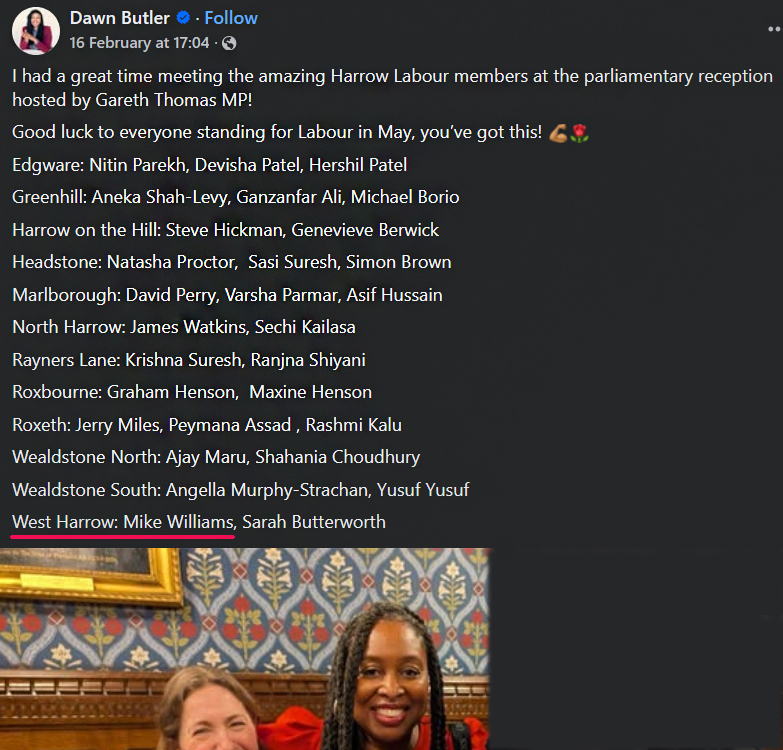
A similar pattern appears in the handling of member conduct. The Council’s Standards Working Group found that Councillor Perry, also Leader of the Opposition, breached the Code of Conduct by using Council resources, specifically the hybrid mail system, for party-political purposes. The sanction imposed was censure, with a requirement for publication in both a local newspaper and on the Council’s website.
While this satisfies the formal requirement, the execution raises concerns. There is no readily accessible or visible notice on the Council’s website or through its social media outlets, undermining the purpose of the sanction. In a local democracy, such findings must be clearly and proactively communicated; otherwise, accountability is reduced to a technicality rather than a meaningful public record.
Taken together, these cases point to a consistent pattern: the Council meets its legal obligations, but fails to be open and transparent with residents. Communication is selective, highly visible messaging that appeals to identity, certain community sentiment, and political positioning is actively promoted, while serious problems are not clearly explained and are left buried in technical reports and procedures.
If Harrow Council is serious about putting residents first, it must move beyond this compliance-based approach and adopt clear, structured, and accessible communication. Without that shift, the claim risks remaining a slogan rather than a standard.
Two years without assurance: why Harrow’s accounts still can’t be verified

Independent audit exists to give the public confidence that their money is being properly managed. In Harrow Council, independent audit assurance has not been provided for two consecutive years.
This is not normal. It is not routine. And it is not acceptable.
The Council has published its accounts, but the independent verification that gives those figures credibility has not been completed. Residents are effectively being asked to rely on numbers that no external auditor has been able to confirm.
For the second year running, the Council’s auditors, Forvis Mazars, have issued a disclaimed opinion. In simple terms, this means they could not confirm the accounts are accurate because they were unable to obtain sufficient evidence to form a view.
No fraud has been identified, but that is not the point. The purpose of an audit is to establish whether financial statements can be relied upon. That basic test has not been met.
Every council is legally required to produce annual accounts showing how public money has been spent, and those accounts must then be independently verified. When that process fails once, it raises concern. When it fails twice, it indicates recurring challenges in the system.
As residents prepare to vote, the issue is no longer just how this situation arose. The question is whether the council can demonstrate that it is being resolved.
A second disclaimed opinion indicates challenges in the Council’s governance and oversight arrangements. This is not about individual effort; it is about whether the Council’s governance framework is equipped to manage the pressures it faces.
When key responsibilities are concentrated in a small number of roles, the risk is not simply one of workload; it is reduced capacity for challenge, limited separation of duties, and weakened oversight. This points to a structural issue rather than an individual one.
The Council’s accounts are prepared by officers, with overall responsibility resting with senior leadership, including the Managing Director and the Section 151 Officer, who holds statutory responsibility for financial administration. However, accountability does not end there.
The Audit and Governance Committee is intended to provide rigorous scrutiny and ensure that material issues are not only identified but resolved. The recurrence of the same outcome for a second consecutive year raises questions about how the Committee’s processes address recurring issues and ensure audit outcomes are resolved.
Absent clear evidence of intervention and improvement, it is difficult to conclude that the Committee is operating with the level of rigour and impact its mandate requires.
The Council has pointed to national audit backlogs as a major factor, citing the National Audit Office’s Local Audit Reset and Recovery Implementation Guidance. These backlogs, combined with statutory deadlines, have meant auditors often lacked the time to complete their work and gather sufficient evidence.
However, this explanation primarily reflects timing and process constraints at a national level. It does not fully address the position in Harrow. This is not simply a case of delay; it is a case where assurance has not been obtained.
While national guidance explains why some opinions are disclaimed due to system pressures, it does not remove the significance of an outcome where the accounts cannot be verified.
Alongside the audit disclaimer, a significant weakness has also been identified in the Council’s financial arrangements, specifically in relation to the Dedicated Schools Grant (DSG), which funds special educational needs provision.
The Council is carrying a growing deficit in this area, and auditors have concluded that its recovery plan is not yet sufficiently developed to provide assurance. In practical terms, there is a financial problem, and the proposed solution is not yet fully established to withstand independent scrutiny.
The Council attributes the DSG overspend to rising demand for Education, Health and Care Plans, increasing complexity of need, and insufficient local provision, pressures that are reflected nationally. However, while this provides context, the scale of the deficit remains significant, and the extent of local mitigation measures to manage demand or control costs is not yet clear from available information.
The distinction is critical: national factors may explain the pressures, but they do not account for the absence of assurance.
After two years without verified accounts, the central question is clear: can the Council demonstrate that its financial management and governance are robust enough to restore trust, and, crucially, provide a convincing explanation for why independent audit assurance remains absent? While explanations have been offered, they have not resolved the underlying concern. Until they do, that assurance remains lacking.
In response, Cllr David Ashton, the Council’s finance lead, focuses primarily on process compliance and audit logistics. He emphasises that statutory deadlines were met, that the accounts were prepared in line with required standards, and that oversight was maintained through the Governance, Audit, Risk Management and Standards Committee.
He links the disclaimed opinion to delays on the part of the external auditor, arguing that insufficient time to complete audit procedures, rather than any issue with the accounts themselves, was the determining factor. This is presented as a sector-wide issue, largely outside the Council’s control.
However, this explanation focuses on procedural compliance and timing. It does not provide detail on measures taken to address the recurrence of disclaimed opinions or ensure that sufficient evidence would be available to support the audit. In essence, it explains what happened, but not why the outcome was not prevented, or what has changed to avoid recurrence.

References
  1. Auditor’s Annual Report 2024–25 (Harrow Council)
    Confirms auditors were “unable to complete the audit procedures necessary to obtain sufficient appropriate audit evidence” before publication, meaning they could not form an opinion on the accounts.
  2. Governance, Audit Committee papers (Feb 2025)
    Notes that a disclaimer of opinion would be issued on the Council’s financial statements.
  3. Auditor’s Annual Report 2024–25 (detailed findings)
    Identifies a “significant weakness in arrangements” relating to the DSG deficit, which grew from £1.8m to £13.8m and is projected to increase further.
  4. External Audit Update report (Nov 2025)
    Highlights concerns about the lack of sufficient alternative actions and ongoing risks linked to the DSG recovery plan.
  5. Governance, Audit Committee papers (Nov 2025)
    Confirms auditors reviewed the DSG recovery plan and assessed whether “appropriate and realistic plans are in place”, indicating ongoing scrutiny concerns.
  6. Auditor’s Annual Report 2024–25 (governance section)
    Concludes there are significant weaknesses in governance arrangements, including areas such as financial sustainability and internal controls.
  7. Governance, Audit Committee agenda and reports
    Confirms ongoing reporting to the committee on audit findings and value-for-money conclusions.
  8. Audit Completion Report (Feb 2026)
    Provides the formal audit reporting framework and confirms continuing audit work on the Council’s financial statements.
  9. External Audit Update (committee report)
    Shows the audit remained in draft/reporting stages, reinforcing that assurance had not been fully concluded.

Harrow Council faces fresh questions over children’s services failings as evidence of improvement remains elusive

Serious questions are being raised about accountability and transparency at Harrow Council after a damning sequence of findings exposed weaknesses in children’s services, yet left little public evidence that meaningful improvements have followed.
In this context, the Council’s emphasis on civic messaging and nationalistic displays, typically appealing to local pride and identity, has drawn criticism from those who argue such efforts risk distracting from unresolved service failures rather than evidencing real progress. Without demonstrable improvement in support for vulnerable residents, these initiatives may struggle to build genuine public confidence.
In October 2025, the Council’s Monitoring Officer, Jessica Farmer, presented a report to Cabinet following a ruling by the Local Government and Social Care Ombudsman, which found fault causing injustice in children’s services and raised concerns about governance and complaints handling. The report acknowledged failings in statutory complaints management and set out actions to strengthen oversight and practice.
Nearly six months on, however, it remains unclear what tangible progress has been made. Public records do not appear to show measurable improvements, nor clear evidence of sustained member-level scrutiny or follow-up. The lack of transparent performance data and outcome reporting raises questions about whether the identified issues have been substantively addressed.
These concerns are reinforced by a February 2026 inspection by Ofsted, which found that children’s services continue to require improvement. While not focused specifically on complaints, the findings cast doubt on the effectiveness of the Council’s governance response.
Taken together, the Ombudsman’s findings and Ofsted’s subsequent judgment point to a persistent risk: that systemic weaknesses identified at senior level may not have been fully resolved. This raises a clear and legitimate public-interest question about whether the Council’s response has been robust enough to restore confidence in how vulnerable children and families are served, and how their concerns are handled when things go wrong.
Therefore, the Council faces a series of pressing accountability questions. What specific actions were implemented following the Monitoring Officer’s October 2025 report, and how were these prioritised? What metrics or evaluation frameworks have been used to determine whether complaint handling has improved in practice? Where is the evidence, whether in timeliness, procedural compliance, or reduced escalation, that demonstrates progress? What formal scrutiny has been exercised by elected members or committees to test and verify these improvements? And crucially, how does the Council reconcile its stated actions with Ofsted’s continuing concerns about service performance?
Until clear, verifiable answers are provided, doubts will remain about whether governance and oversight arrangements are operating effectively, or whether the same systemic issues risk persisting beneath the surface.

Ofsted’s second monitoring visit exposes deeper failures in Harrow Children’s Services – with signs of deterioration

The second monitoring visit by Ofsted to Harrow’s children’s services (their letter of 12 March 2026, copied to the Department for Education) confirms that the problems identified in early 2025 were not isolated weaknesses but symptoms of wider systemic failings. While leadership changes are under way, they remain too recent to influence practice, and the overall picture since the previous monitoring visit in September 2025 is not improvement but widening concern.
The latest inspection has expanded its focus to fundamental issues of safeguarding and children’s wellbeing, including the quality of assessment, planning and review, and the effectiveness of Independent Reviewing Officer (IRO) oversight, revealing gaps that mirror those long raised by the Harrow Monitoring Group. The result is a sobering conclusion: despite formal intervention and public assurances, the experiences and progress of children in care have not been sustained and in some respects have deteriorated.
This Ofsted inspection marks a significant moment in the borough’s prolonged struggle to restore confidence in a service once rated “good”. When Ofsted judged the service “inadequate” in January 2025, the decision triggered a government improvement notice and an abrupt leadership crisis, including the departure of the director of children’s services later that year. What followed, however, was not the decisive structural reset that such a judgement should have provoked. Instead, the council’s response appeared cautious and incremental, while the deeper organisational weaknesses continued to shape frontline practice.
The latest monitoring visit therefore matters not simply as a routine check but because its scope has widened considerably. This shift reflects a recognition that the problems in Harrow’s children’s services are not confined to particular outcomes but extend to the basic architecture of care planning and professional accountability.
What matters now is whether the council responds with the urgency and transparency the situation demands. Children in care cannot wait for organisational cultures to adjust gradually or for leadership teams to settle into new roles. Their need for stability, safety and permanence is immediate. If the latest inspection demonstrates anything, it is that improvement delayed is improvement denied, and that the cost of such delay is borne not by institutions, but by the children they exist to protect …….. Link to full article

Call for peace from Harrow MP contrasts with divisive rhetoric at home

At a time when some Conservative politicians are using social media platforms and sympathetic right-wing outlets to inflame imported communal tensions for political gain, alongside what critics describe as racially charged efforts to undermine London’s mayor, Sadiq Khan, attacks that have intensified following the election of a dynamic new mayor in New York City, it is refreshing to see a more measured and reflective contribution to the international debate and to local community cohesion from Harrow’s representative at Westminster.
The contrast is noted locally, where critics say the Conservative administration at Harrow Council has failed to clearly distance itself from divisive voices seeking to exploit tensions and fracture what has long been regarded as one of the borough’s most socially and racially harmonious communities.
Gareth Thomas, Labour MP for Harrow West, has acknowledged that people across the borough are understandably worried about the escalating conflict in the Middle East and what it could mean both for the UK and for the many families in Harrow with close personal and cultural ties to the region.

Thomas said that, following requests for defensive support from Gulf partners, the UK has taken limited defensive action while continuing to push for de-escalation and a return to diplomacy. He emphasised that Britain is not participating in offensive strikes against Iran and that the Government’s stated focus remains on protecting British interests while preventing a wider regional conflict.
While global attention is understandably focused on the fast-moving situation involving Iran, Thomas stressed that the international community must not lose sight of the ongoing crisis in Palestine.
“Now that the UK has recognised the State of Palestine,” he argued, “the Government must match words with action,” urging ministers to take concrete and practical measures if the prospect of a viable Palestinian state is to remain realistic.
His call for action includes banning all trade and interaction with illegal Israeli settlements, expanding sanctions on violent settlers and extremist groups, and publishing the UK’s formal response to the advisory opinion issued by the International Court of Justice.
Without decisive steps, Thomas warned, the possibility of a viable Palestinian state will continue to disappear, and with it the prospects for a just and lasting peace. For many residents in Harrow, where international developments resonate deeply within diverse local communities, the call for diplomacy, restraint and principled leadership abroad is a matter of immediate local concern as well as global importance.

Unholy divisive politics over Harrow’s Holi celebration

An attempt to politicise a community celebration in Harrow has drawn criticism from local voices who warn against fuelling division for political advantage.
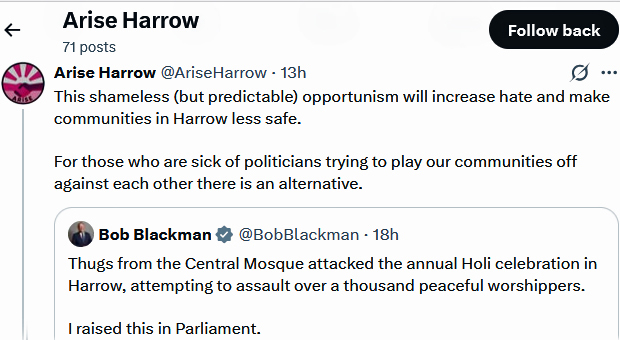
In a statement at the House of Commons, Bob Blackman, Conservative MP for Harrow East, alleged that “thugs from the Central Mosque attacked the annual Holi celebration” and claimed that the Metropolitan Police had “questions to answer” after only one arrest, a veiled attack on London Mayor Sadiq Khan, who oversees the Met Police.
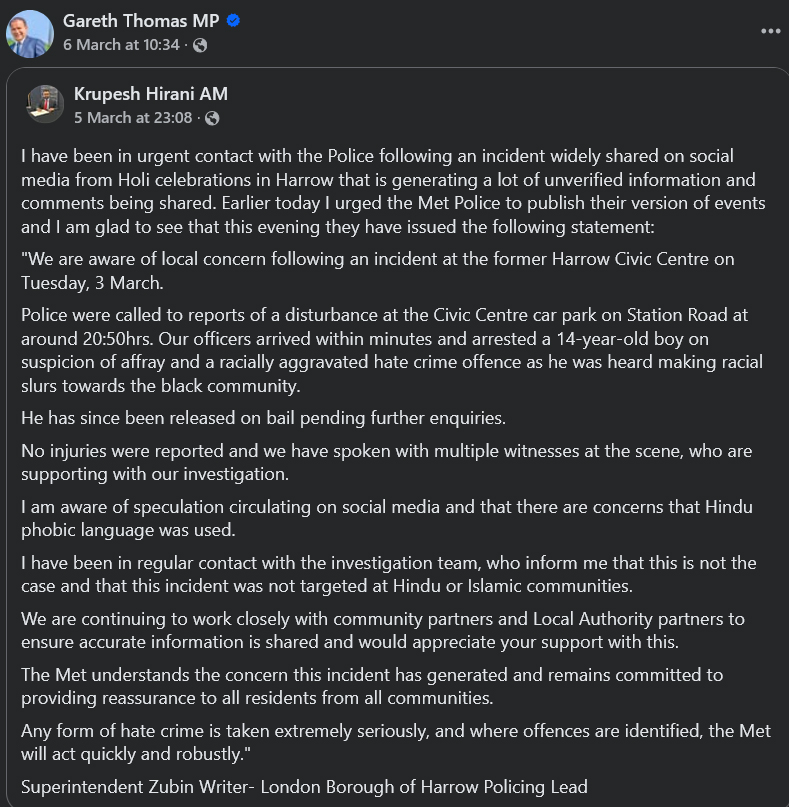
However, police statements following the incident indicated that investigators found no evidence that the disturbance at the Holi event had any Hindu–Muslim dimension. This assessment was echoed by the Conservative leader of Harrow Council, who confirmed that police “do not believe the Harrow incident was targeted at the Hindu community”.
Despite these clarifications, the MP’s version of events has been circulated by some right-wing commentators and media outlets, prompting concern that an unverified narrative could inflame tensions within one of London’s most diverse boroughs.
Local politicians and community representatives who have long championed Harrow’s interfaith harmony have instead urged residents to rely on the facts established by police and avoid speculation that risks damaging community relations.

New Contact Centre opens the door, but will Harrow council listen?

Harrow Council has announced plans to open a new Contact Centre on Gayton Road, promising residents a long-awaited central point where they can seek help face to face.
For many residents, the restoration of a physical customer service hub will be welcome news. In recent years the borough has relied heavily on digital forms, call queues and automated systems, leaving some residents, particularly older people or those with complex cases, feeling there was no straightforward way to speak to someone in person.
The timing of the announcement is also notable. With council elections scheduled for May, the reopening of a walk-in contact point allows the authority to present itself as reconnecting with residents and responding to longstanding concerns about accessibility and responsiveness.
However, the announcement has also prompted questions about how effective such a centre will be if wider council practices continue to discourage direct engagement between officers and residents.
Many residents say they have struggled for years to receive responses from council departments. Some claim that senior managers and cabinet members mostly fail to respond to written correspondence. Complaints also frequently centre on the difficulty of speaking directly to officers responsible for decisions.
Residents dealing with housing repairs, for example, have reported long delays when trying to escalate urgent problems. Many say they are repeatedly redirected to online reporting systems without being able to discuss their case with a housing officer.
Concerns have also been raised about planning applications. While consultations formally exist, residents say meaningful dialogue with planning officers can be difficult to secure once submissions have been made.
Others reporting persistent environmental issues, such as fly-tipping, street cleaning or noise complaints, say follow-up communication is often limited, leaving them uncertain whether their concerns are being addressed.
Critics argue that without broader changes to internal policies and engagement practices, a physical contact centre could risk functioning mainly as a front desk that directs residents back into the same digital or departmental channels that have caused frustration in the first place.
As the borough approaches the May elections, residents will be watching closely to see whether the Gayton Road contact centre represents a genuine shift toward more open engagement or simply a symbolic gesture at a politically sensitive time.

Labour opposes Harrow council budget but puts forward no alternative

Conservative councillors at Harrow Council have approved a budget that will increase council tax by 4.99% in 2026/27 and expand council borrowing.
The increase means the average Band D council tax bill will rise to £2,511, up by almost £500 over the past four years, an overall increase of around 20% since 2022.
The budget also confirms that council debt has risen by £70 million since 2022, with plans to borrow a further £92 million over the next two years under the authority’s Medium-Term Financial Strategy.
Labour councillors voted against the proposals, arguing that the budget places additional pressure on residents during the cost-of-living crisis. They also criticised what they described as avoidable spending over the past two years. Examples cited include £300,000 spent repairing a leisure centre roof, £180,000 on installing and later removing concrete planters in Harrow town centre, more than £350,000 to clear a large fly-tip near Harrow Leisure Centre, and over £643,000 committed to refurbishing and operating a new council chamber at the Ridgeway site in West Harrow.
Labour group leader David Perry described the budget as “a disaster” and said his group could not support measures that, in their view, increase tax burdens while failing to prioritise frontline services.
Conservative councillors defended the budget as responsible financial management amid inflationary pressures and rising service demands. Finance portfolio holder David Ashton criticised Labour’s position, arguing the opposition had failed to offer an alternative.
“It’s a bit rich for Labour to criticise,” he said. “They wasted £50 million on a council building at the Depot, which was both ridiculously costly and in an inappropriate location.
“They highlight a few relatively small costs, out of the £100 million we have spent efficiently and frugally.”
Cllr Ashton also noted that Labour did not present an alternative budget or submit motions during the council meeting.
“They seem bereft of ideas and have nothing to contribute,” he said. “Their conduct at the meeting suggested a party that can only carp, with nothing positive to offer.”
The budget was passed ahead of May’s local elections.

Harrow report admits financial incentives may prolong restrictive placements for disabled children

A Cabinet report at Harrow Council has raised serious safeguarding and governance questions after acknowledging that financial incentives in the residential care market may encourage providers to keep disabled children in highly restrictive placements longer than necessary.
The report, “In-House Residential Provision for Children with Disabilities,” considered by Cabinet on 18 December 2025, was authored by Liz Barter, Assistant Director for Children and Young People with Disabilities (CYAD), the officer responsible for overseeing specialist disability services and residential placements involving children with complex needs, including those subject to deprivation of liberty arrangements.
In a notable passage, the report states that private providers may have “a perverse incentive… to avoid supporting the progression of residents and maintaining higher staffing numbers for financial reasons.” In effect, the council acknowledges that financial pressures within the residential care market may encourage providers to maintain highly staffed placements and delay children moving to less restrictive settings.
Despite that admission, the report frames the issue primarily as a commissioning and cost-control problem. Rather than proposing a safeguarding review of existing placements or reassessing whether restrictive arrangements remain necessary, it discusses negotiating reductions in staffing levels with providers and developing in-house residential provision to regain control over care packages and placement costs.
The proposal asks Cabinet to delegate wide authority to officers to progress the project, including identifying and acquiring property, approving capital and revenue budgets, refurbishing premises, securing registration from Ofsted, and opening the home.
The governance context adds to the sensitivity. Harrow Council Children’s Services is currently operating under an improvement notice from the Department for Education following an inadequate judgement by Ofsted, and the authority’s Director of Children’s Services left the role in November 2025, with the statutory position now being covered on an interim basis.
The report itself identifies no safeguarding review of current placements, no project risk register, and no Equality Impact Assessment, stating that moving to in-house provision would not change the equality impact.
The concerns are not being raised externally: they appear in the council’s own Cabinet paper authored by the senior officer responsible for the service. That raises a central question about where corporate parenting scrutiny is operating in practice when the welfare of some of the borough’s most vulnerable disabled children is involved — particularly in a local authority already criticised for systemic weaknesses in its children’s services.
Against that background, critics say the episode reinforces a wider concern: that Harrow Council is “coasting while core services fail those who rely on them most.”

Council rebuts Labour claims following cabinet meeting

Following the Cabinet meeting of Harrow Council on 19 February 2026, the Labour opposition alleged that a local resident was branded a “disgrace” by the Council’s Deputy Leader after raising, through a public question, the case of a mother and baby reportedly hospitalised due to a damaged pavement in West Harrow.
An opposition press release named the questioner and described him as a “longstanding community advocate” in West Harrow (reportedly a Labour candidate for the forthcoming council elections) who was highlighting concerns about the distribution of road resurfacing funding across the borough during an exchange with the portfolio holder, David Ashton.
Leader of the Harrow Labour Group, David Perry, said: “People in Harrow deserve better and a council that takes responsibility instead of calling concerned residents a disgrace. This Tory administration appears desperate to blame anyone but themselves for their mistakes. Instead of taking responsibility for resident safety and requesting further details of the case raised by a local community advocate, Conservative councillors running the council chose to dismiss the resident for even raising the issue.”
Deputy Leader Marilyn Ashton rejected Labour’s account, disputing claims that public safety concerns were dismissed or that the resident in question was verbally abused during the meeting. The webcast of the meeting shows no exchange between Cllr Marilyn Ashton and the questioner.
Reflecting on the Cabinet meeting, Cllr Ashton said the public question carried a political tone that sought to cast doubt on the portfolio holder and his clear and honest responses to what she described as repeated and unfounded accusations.
She reiterated the administration’s position, stating: “Public safety is non-negotiable. Our highways programme is determined by need, professional assessment, and available resources. We will continue to engage with residents respectfully while also challenging claims that misrepresent the work being undertaken across the borough.”
The Council confirmed that any specific pavement incidents raised through formal channels will continue to be investigated in accordance with established procedures.