Child poverty

CPOver 30% of children in Harrow live in poverty where child poverty is rising to 40% in some wards – but there seems to be no urgency to solve poverty either by public or the authorities.
Harrow council report,  Child Poverty And Life Chances, reports that the poverty rises in some of the more deprived areas of the borough:  Roxbourne has the highest percentage of child poverty levels with 28.5% (before housing costs) rising to 42% after housing cost. Wealdstone, Marlborough, Greenhill, West Harrow, Queensbury and Roxeth have the next highest child poverty levels in the borough.
Harrow is a part of the system where there are 151 billionaires in the UK and 14 million people in poverty, including 4.1 million children in 2017-18 (Commons Briefing papers SN07096 and Child Poverty).
Children from Black and minority ethnic groups are more likely to be in poverty: 45 per cent are now in poverty, compared with 26 per cent of children in White British families, Child Poverty reported.
The Resolution Foundation’s projections suggest child poverty will rise within the next five years, and will be 6 percentage points higher in 2023/24 than in 2016/17: equivalent to an extra 1 million children in poverty, informs the Commons briefing report. This is bound to reflect in the Harrow profile as more and more social housing is provided in the borough.
The Child Poverty Act 2010 required local authorities and their partners to cooperate to tackle child poverty in their local areas but child poverty has never been high on the agenda in Harrow since the Act came into force because Harrow isn’t comparatively deprived at a borough average level.
Although the council budgetary situation does not help to allow to make valuable local connections across services and adequately focus on early intervention and prevention, Harrow has a child poverty action plan based on five priorities [including health and well being of children, support for families with housing, and tackling financial exclusion like debt management, financial literacy, affordable credit and maximise benefit take up].
However, the structure and programme to implement the plan is not impressive.
The Plan has no stated success criteria; for example, in terms of health and educational outcomes.  Actions and progress towards achieving unspecified outcomes is seemingly monitored by the child poverty task group (?) which reports into the health and wellbeing board who seems to have ultimate responsibility for owning the child poverty strategy and action plan.
Many say that the board gives sense of being a talk-shop which mostly notes reports rather than commanding improvement in the services.
Very odd that having identified strong connection between child poverty and child welfare, child poverty is not treated as a safeguarding issue and addressed within the Harrow structure of safeguarding children.

 

Harrow schools latest results

EDMajority of Harrow schools, including the state funded schools, are achieving higher, and some much higher, results than England average, according to the school performance data published on gov.uk.
However, A-level performance is broadly average.  Average point score per entry and AAB or above with at least two results being in “facilitating subjects”, most valued by top or mid-range universities, are not good enough and below Barnet or Brent.
Harrow leavers (as %) destination to mid-range or top higher education institutions like Oxford, Cambridge and Russell group of universities is therefore less secure which is likely to be a big disappointment for parents/carers who have high expectations of Harrow education.
The sixth form picture is concerning as most pupils move on to university on completion of their A-levels.
Further concern is that while Harrow pupils are generally doing very well up to KS4 and they progress to the sixth form mostly at the same school, why their performance is not sustained at the last stage of their schooling?
The sixth form pupil profile (or general population profile) in Harrow is not much different than that in some neighbouring boroughs which comparatively seem to be doing better.
Regarding the overall quality of the education outcomes in Harrow, healthy comparison could be with next door  Brent: Harrow is not, but Brent was included in the highest performing local authorities in 2017 and in 2018 it was included in best-performing academy trusts. In terms of ranking, Redbridge, Westminster, Brent and Kingston upon Thames were all among those performing above average in 2020.
Overall performance at end of Key Stage 2 (11 yrs) in 2019 – all pupils (58 schools):
At the end of Key Stage 2, 74% Harrow pupils met expected standard compared with 65% for England; and 15% of pupils achieved a higher standard (England 11%).
In 13 primary schools expected standards were much above England average, in 14 well above, in 8 above, 1 below and 2 well below the average – for others no data was available or applicable.
Overall performance at end of key stage 4 (16 yrs) in 2019 – all pupils (25 schools):
At the end of Key Stage 4, 50% Harrow pupils achieved Grade 5 or above in English & maths GCSEs (England 40%). Three high schools achieved much higher than England average; 4 above average and 3 below the average.
Harrow entered more in EBacc (65% – England average of 37%). Most schools entered well above, and two well below average.
The English Baccalaureate (EBacc) is a set of subjects at GCSE that keeps young people’s options open for further study and future careers.
Harrow Progress 8 is higher than England average – 5 schools well above, 2 above, 3 average and 2 below average. Progress 8 is government’s “headline measure” for judging schools. It shows pupils’ progress between primary school and GCSE in eight subjects.
Harrow Attainment 8 score at 50.9 was higher than England average (44.7):  8 schools’ score was above or well above the England average and 3 below the average.
A school’s attainment 8 score is the average of all of its secondary school students’ scores.
No data available or applicable for other school or college.
A level performance at the end of 16 to 18 in 2019 – all students  (23 schools and colleges):
Harrow is okay in A-level performance: achieving Grade C+ (pass 60-64%) in line with England average C+ (average grade: 2 schools had B-, 4 had C+,  2 gaining C and and two D+) but below England average in Point Score (33.14 against England 34).
Harrow A-level results are also below the England average in ‘AAB or higher in at least 2 facilitating subjects’ (12.2 against average 16.5) but slightly above the average in grade and points for a student’s best 3 A levels  (C+ 34.34 against average C+ 33.96).
From the data it appears that Harrow in not doing that well in A-levels at the state funded schools (vast majority academies).
Local authority & HSSE: given (a) the performance variations across the Harrow schools/education phases as well as secondary schools rank fluctuations from year to year, based on public examination results – in a few cases from ‘outstanding’ to a failing category (Ofsted) over time (b) few schools performance below average for long (c) the overall A-level performance dipping to average, Harrow School Standards and Effectiveness (HSSE) team and local authority roles become more challenging in monitoring school performance and ensuring that the schools maintain consistent and high standards across the education phases.
Hope professionals and politicians would work together to regain Harrow’s impressive position in education.

NICL

NCILConsultation meeting to improve South Harrow this month gave rise to concerns how well the Neighbourhood Community Infrastructure Levy (NCIL) funds have been used as councillors assertively floated the idea of spending £20k to £30k each on three murals.
An attendee later said that the meeting felt like consultation on a pre-determined outcome –  little was known about NCIL!
The meeting involved councillors, police, residents, community groups and traders.
There appeared uncertainty whether like other councils, for example Brent, can Harrow community groups apply for the funds for the projects they consider more important, for instance those specific to  street furniture, upgrading of park facilities etc?
In helpfully responding to the Harrow Monitoring Group enquiry, David Corby, head of community engagement service, said: “We always welcome projects that will have a wider benefit to the local community.
The Neighbourhood Community Infrastructure Levy (NCIL) offers an opportunity for the council to engage with local communities to help fund small projects to support the local area – such as CCTV, gates for alleyways and improving Town Centres “.
He said the community engagement team engage with local groups to agree on how best to spend NCIL funding through consultation and engagement process such as community champions and park user groups.
Applications can be submitted to the Council’s Community Engagement team at community.engagement@harrow.gov.uk  but the information about NCIL funds or the process for the community groups to apply for the projects are not really publicised. 
The Community Infrastructure Levy (CIL) is a levy on new developments to ensure that costs incurred in supporting the local area is funded by owners or developers of land.
Under the CIL Regulations 15% of CIL funds must be spent on projects that take account of the views of the communities in which development has taken place. But the downside is that the ‘view-seeking’ could be subjective, driving towards a pre-determined outcome.
CIL  Income and Expenditure  generally:
The amount of unapplied CIL brought forward from the previous year(s) to 2018-19 was £5,562,410 (comprising £3,926,240 borough CIL and £1,636,170 neighbourhood CIL).
A total of £14.5m of Harrow CIL has been received since 2013/14. Taking into account the 51 College Road infrastructure agreement, this increases to £17.8m.
Total expenditure or agreed allocation of borough CIL on infrastructure projects is £10.4m, or circa 89.5% of borough CIL receipts (£11.6m). Including the 51 College Road infrastructure agreement / new central library, this increases to £13.7m or 91.7%of total borough CIL receipts (£14.9m).
This expenditure is mostly on public realm improvements and parks / open space, and some capital programme.
Total expenditure or agreed allocation of neighbourhood CIL on infrastructure projects is £381,227, or 17.5% of total neighbourhood CIL receipts (£2.2m), mostly on public realm improvements or developing certain areas like Squares.
Harrow could do more to develop well publicised process for inviting community groups to apply for the projects under NCIL – Brent is a good example.

Would Harrow council fly union jack on Prince Andrew’s 60 birthday?

The Ministry of Housing, Communities and Local Government has instructed councils to fly the union flag on February 19 to mark Prince Andrew 60th birthday.
Some councils have already rejected the instructions being “wholly inappropriate in the prevailing circumstances“.
Harrow civic centre needs not to take any notice of the government’s directive as they have the right facility and do fly the union flag every morning anyway!
Andrew stepped down from royal public life in November after his disastrous Newsnight appearance, and the Queen cancelled her son’s formal birthday celebrations soon after.
The interview was criticised for showing a lack of compassion for sex trafficker Jeffery Epstein’s victims and failing to show regret over his friendship with Epstein.
Virginia Giuffre, formerly Virginia Roberts, claims she was trafficked by convicted sex offender Epstein and alleges the duke slept with her, including when she was a minor under US law.
Prince Andrew, who denies the allegations, is facing calls to talk to the FBI and US prosecutors.

Selection of Brent and Harrow Labour candidate in final stage

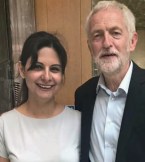
candidateMomentum backed Aghileh Djafari-Marbini (photo with Corbyn) and Brent councillor Krupesh Hirani are on the One Member One Vote ballot where the party members will decide who will be the Labour candidate representing Brent and Harrow. Voting will commence on 5th February.
Aghileh Djafari-Marbini, a socialist, mum, school governor, NHS worker and resident of North West London for the last 20 years, believes that Londoners need an Assembly that fights the inequalities and injustices in their city and works for all.
She recalls seventy-two fellow citizens burned to death in Grenfell Tower and over 87,000 children in London are homeless, and says that the savage Tory cuts have decimated our youth services and damaged our town centres.
“Now more than ever London needs a City Hall with a socialist vision and the energy to engage people across the city” she says.
It would be interesting to see how well she is supported by those less keen on Momentum or Corbyn.
Labour is going through the selection process because Navin Shah, the sitting assembly member with over 20,000 majority, has decided to step down.  Navin Shah has retained the seat since 2008 when he defeated Tory member Bob Blackman, now controversial MP for Harrow East (Navin Shah came very close to defeat him at the last general election).
HirBrent councillor and a council cabinet portfolio holder Krupesh Hirani (photo), university graduate in politics, has good experience in the political sector where he held a number of posts.

During the Operation Black Vote Shadowing Scheme Mr Hirani was mentored by David Lammy MP. He seems to have good grip on a variety of socio-political matters, relevant to a wider society.
Though Mr Hirani is seen more at certain cultural activities, he says he believes in representing all. Mr Hirani informs that he has spent his working life with organisations that support disabled people.
Mr Hirani is proud of the local area and said: “I have been educated through the Brent state school system and am passionate about the area”.
Two Harrow councillors, both previous Harrow mayors, failed to reach the final stage of the selection process.
Tory candidate for the seat is karate champion Molly Irene Samuel-Leport MBE from outside Brent or Harrow.

Increased crime against retail workers needs focus

“No one should go to work fearing violence or threats” says Harrow West MP Gareth Thomas.
At the Commons debate on Policing and Crime on 29 January 2020, he pointed out that one particular area of crime that is on the rise is crime against retail workers.
“They face increasing threats of violence, many involving a knife and many, sadly, involving guns, particularly where age-restricted products are involved” he informed.
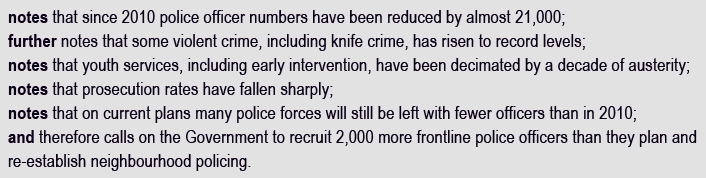
The debate took place as Diane Abbott Shadow Home Secretary moved a motion, asking that this house:
Policing
Tory majority, including Harrow East MP Blackman, voted no on Policing and Crime.
The debate heard that police resources in Scotland are much healthy where police officer numbers are up by 1000, despite significant cuts to Scotland’s budget from Westminster. As of 30 September 2019, the total police officers were up 1,022 on 2007 figures. Scotland has more officers per head of population than in England and Wales. The ratio in Scotland is 32 officers per 10,000 members of the population versus 21 officers per 10,000 members of the population in England and Wales.

Harrow to make council tax rise less painful for some

Following the last year’s maximum legal limit increase (4.99%), the council tax rise for 2020-21 is close to 4% which, like previously, has serious implications for those worst affected by government cuts.
Harrow follows the London pattern where the poorest pay 8.1 per cent of household income in council tax, while for those in the top income decile contribute just 1.3 per cent of their earnings.
This disparity is mainly because property valuations, on which the system is based, have not been updated since 1991, while house prices have rocketed. But the inability of cash-strapped local authorities to offer the poorest full relief from the tax as was the case in the past, when the relief was funded by central government, is another factor.
Harrow has agreed to invest an extra £400,000 a year to help those worst affected by government cuts. The new funding will give extra Council Tax relief to families on Universal Credit, freeze Council Tax for low-income households, and create a new Council Tax Protection Fund for people.
Under the new Fund, families making their first claim for Universal Credit will receive a two-week Council Tax discount, helping to see them through the long wait before they get their first payment.
Universal Credit is a single payment designed to replace the current benefits system. The amount of Universal Credit can change as people’s income changes, and claimants can wait six weeks for their first payment. This means frequent changes to Council Tax Support, uncertainty for claimants and higher costs for the council.
Cllr Adam Swersky, cabinet member for finance, said “The wait for Universal Credit can be an especially uncertain and worrying time and can force families to rely on food banks or even become homeless. Our new investments will make thousands of people better off at their time of greatest need”.
Tory opposition group on the council once again let down the residents as they failed to produce a shadow budget, and therefore missing opportunity to hold the administration to account through well informed argument.


No to Tory play!

15120 titleOpposition Tory group on the Harrow council has failed to produce a shadow budget which they owe to the residents, but instead indulges in political point-scoring about the general election results in Harrow.
They asked the forthcoming Council meeting to debate a motion regarding the local outcome of the 2019 general election. The mischievous motion has now been rejected by the chair, Harrow mayor, for being  inappropriate.
The rejected motion noted that Harrow East MP Bob Blackman returned with an increased majority while Labour MP Gareth Thomas returned with a reduced majority.
According to the Tories, this represented a “round rejection of the Marxist ideology” associated with the Labour leadership (Jeremy Corbyn).
While the Labour candidate for Harrow East Pamela Fitzpatrick ran a clean and positive election campaign, Bob Blackman relied on exploiting Indian and Jewish background voters and ran an aggressive smear campaign against Labour leader and the candidate.
In his election letter he described the Labour leader Jeremy Corbyn as being “under the thumb of Momentum, who has revelled in regarding terrorists as his friends, regards Venezuela as a role model and failed to root out antisemitism and an anti-India culture which has become entrenched in his Labour party” and then posed a question whether he should be voted in or the “Jeremy Corbyn’s representative in Harrow”.
According to Harrow’s constitution, motions can be declared invalid if they risk defamation, are frivolous or offensive, do not relate to the council or the borough, could disclose confidential information, or have been discussed at full council in the last six months.
Quite rightly, sober Harrow has no place for allowing foreign helped anti-Corbyn hysteria to divide the community.
But of course the Tory group deputy leader Cllr Ashton, backbone of the Harrow East conservatives that nurture the divisive characters like the Belmont Cllr Patel and Blackman, thinks otherwise and rubbishes the mayor’s wise decision.

Harrow much behind in suicide prevention measures

SPWhilst all councils are expected to develop and implement a Suicide Prevention Action Plan, and many have, Harrow currently does not have an up to date Plan.
Documents before the forthcoming Health and Wellbeing Board inform that a coordinated and new Plan is required which will enable a strategic approach to suicide prevention, particularly where services cross over in to neighbouring boroughs such as Brent.
Data produced from Public Health England (PHE) show that suicide rates for all persons during 2016-2018 in Harrow, is 6.4 per 100,000 compared with England’s rate of 9.6 and London’s rate of 8.1 per 100,000.
The data also show that the suicide rate for men in Harrow mirrors the national picture, where rates for men are higher when compared with females. The suicide rate for men in Harrow is 9.0 compared with 3.6 for females. However, nationally, rates for females taking their own lives are increasing.
Now a draft Action Plan that has been developed by Brent and Harrow Public Health and is before the board, aims to reflect actions on the national six key priorities including self-harm.
The Plan has been developed in partnership with local organisations that either commission or deliver services related to mental and emotional health, suicide and bereavement support, using data mostly generated by them.
The Plan has 31 actions across each action area ranging from promotion of suicide prevention training in businesses to supporting schools to deliver suicide prevention messages.
The Action Plan that will focus on the tackling suicide rates in men and children and young people in Year 2019-2020 is not costed nor shows success criteria.
The plan of this nature cannot be without resources implication. For example, imaginative preventive measures include audio/video resources like a guide to suicide prevention in easily digestible presentation format to help anyone needing to make the case for suicide prevention and key areas of work within this. The resources could also include charts, images, maps, statistics, quotes – that are useful for illustrating the importance of suicide prevention.


Blackman not honest about NHS

bb4Hustings after dustings in Harrow, Bob Blackman, than Tory candidate and now MP for Harrow East, assured that NHS is not up for sale – but it is!
After misleading Harrow residents this way, he sought temple blessings in vote capturing exercise without any confession. It would be difficult to disagree with those who say such an opportunist can’t be trusted!
‘Private firms invited to run NHS services with cancer and kids treatments on sale’, Sunday Mirror reported on 28 December 2019.
Bids for chunks of the health service are invited in complete contrast to Boris Johnson ’s repeated election campaign denials.
Cardiology, gynaecology, paediatrics and oncology are among the services being offered to companies.
A new framework drawn up by NHS Shared Business Services for hospital trusts to buy clinical care from a list of suppliers, could lead to deals worth up to £117million being handed out over four years.
Furthermore, trade experts have pointed out that there is a degree of inevitability that, when agreeing a free trade deal (FTD) with the US, it would automatically expect access to the healthcare and pharmaceutical industry in the UK.
Apart from giving publicity to those who hold hustings, including the places of worship, the hustings are out of date and waste of time activity as they do not have any mechanism to hold the candidates to account once they are elected.
It would be appropriate for the hustings-holders in Harrow to ask Mr Blackman why he misled about the NHS future, and then make his apology public.
Also ask Gareth Thomas, MP Harrow West, how exactly he is going to implement his sweeping statements at the hustings about this or that?