
Harrow people do less physical activity!

activeIt can only be good that Harrow is intending to bid for up to £13million to become a Sport England pilot area to attract local people who don’t already do much physical activity.
Harrow has higher proportion of inactivity and performs low in required levels of physical activity (including active travel) compared to the national and London average. Areas of low activity coincide with areas of deprivation, low access to green space and those areas with high obesity levels.
1 in 3 adults in Harrow are inactive (less than 30 minutes activity per week). Two thirds of adults are obese.
Harrow council is responsible for providing sport and leisure services locally.
Guidelines for adults aged 19-64 to stay healthy include at least 150 minutes of moderate aerobic activity such as cycling or fast walking every week, and strength exercises on two or more days a week that work all the major muscles (legs, hips, back, abdomen, chest, shoulders and arms).
Physical activity levels also vary by household income. In England, 76% of men in the highest income quintile reached recommended levels, compared to 55% of men in the lowest income quintile. Harrow has areas of high deprivation.
The GLA has recently published a suite of 33 bespoke guides for each London borough describing the links between health and some of the key environmental determinants including Active Travel & Transport, Air Quality and Green Spaces. The guides aim to influence local borough decisions and how budgets are decided and allocated.
“We want to ensure that our planning, transport and regeneration programmes promote and encourage active lives from the moment our residents step out of their front doors with pleasant and safe spaces for walking, cycling, exercise and social activities” said councillor Sachin Shah, leader of Harrow Council.
Research shows that interventions in the walking environment for example, can lead to higher numbers of people taking part in outdoor activities and spending time outside their homes.
Hope the leader’s good intentions are fully reflected in the council budget.

Last cabinet meeting caused ‘storm in teacup’!

How very interesting that a complaint has been made to chief executive of Harrow Council about the conduct of last cabinet meeting and the leader of the council who was chairing it, knowing well that the chief executive has no jurisdiction over either of these matters.
Also interesting that while the call out by a resident at the meeting when the Tory opposition leader Cllr Hall (photo) was speaking has been capitalised,sands no similar concerns have ever been reported to the council about Cllr Hall’s disruptive behaviour at the cabinet meetings chaired by Cllr Sachin Shah (photo).
For example, the Harrow Times reported on 14 Oct 2016, “Cllr Hall continued to ask questions, despite being told her allocated time was up. She held up a megaphone created from a blue piece of paper, which she had made before the meeting, and said to Cllr Shah: I’m tired of you turning my microphone off.”
Criticising the administration is one thing but hateful personal attacks on its leader, whoever he might be, as indicated by the Cllr Hall’s tweets, again reported by the Harrow Times, is a very different and concerning matter.
Regarding the call out by the resident at the meeting, mature politicians have/ should have the ability to take it on the chin – you can’t just tell the member of public off for spontaneous and emotional outbursts, especially regarding sensitive matters like mental health.
It is very worrying that when elected, some councillors feel untouchable and look down at the residents.
There are many examples of harsh comments/ interruptions at some cabinet meetings where no action was ever taken against the residents for showing respect to the resident’s right to emotional expressions.
For example, during the last council, the chairing leader of the council at the time was regularly personally targeted, including inference to his spoken English.
We hope there is no build up to topple another Asian leader* of the council.

*In mid-2013, a breakaway Independent Labour Group, snatched the council administration from Labour with the support and encouragement from the Tory group leadership. Few months later, the Tory group grabbed the council administration through a highly controversial process and ousted the ILG’s Sri Lankan leader of the council. Harrow finished up with an elected-mayor style short-lived Hall administration and three different council cabinets and administrations within a short period.

Harrow primary schools – mixed performance!

school-sign-jpg-galleryWhile Harrow primary schools are doing well against the national benchmarks overall, there are significant variations in the performance of the schools.
The primary (key stage 2) results announced this week show big gaps. For example, 90 percent of pupils meeting the expected standard at a top school and only 28 percent at the lower end, against the 53 percent national average for all schools.
Majority of the schools are above but fourteen percent below the expected standards.
Similarly the percentage of pupils achieving at a higher standard varies between 24 and 1 percent where 18 percent are below the national average (5%).
With some variations, Harrow average of disadvantage pupils meeting the expected standard (47%) is higher than the national picture (39%).
No surprise about such variations as the narrowing the gap in the achievements – both at the pupil and school levels – has remained a big challenge for Harrow.
The well organised Harrow School Improvement Partnership (HSIP) works well to ensure that schools in Harrow have access to high quality, locally available school improvement provision but there is a limit to what they can do under the available resources – only 5 active advisers and barely adequate budget.
Further implication is the increasing government demands on the schools to do more and more with a shrinking budget.
Added to this, schools are set to lose further money from their budgets as a result of the government’s new funding formula.
Under the government’s recently announced proposals, more than 9,000 schools in England will lose funding, with money moving from London and other urban centres that have been well funded in the past to schools in areas that receive less money.
Already about one third of Harrow Primary schools are below the national income per pupil (£4,732) – sum of grant funding and self generated income.

Left hand doesn’t know what the right hand is doing!

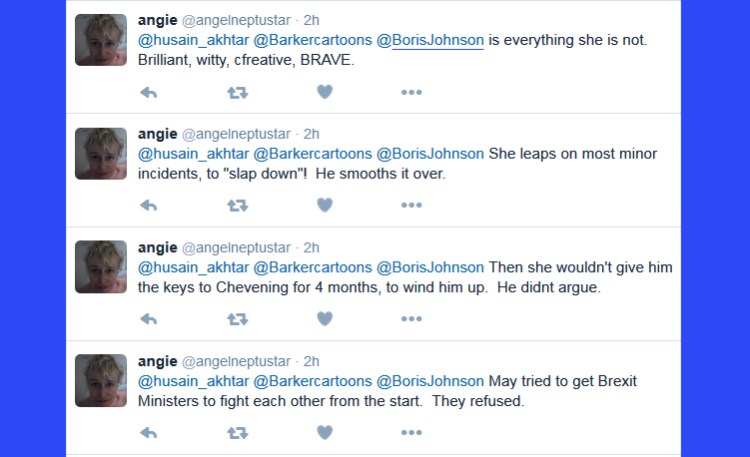
The rift between Theresa May and Boris Johnson became obvious as Downing Street said that foreign secretary Boris Johnson was not representing the government’s views on Saudi Arabia when he recently accused the state.
Both of them have been in Harrow to support unpopular Tory group leadership that has failed in making any election gains since 2010. Cllr Hall now leads a highly divided group where 42.31% members of her group did not vote for her at the recent leadership election, contested by Cllr Marilyn Ashton, past chairman and a powerful officer in the Harrow East Conservatives Association.
Like in Harrow, Theresa May appears to be self imposed leader as many think this unelected prime minister is not prime minister material.
The recent prime minster and foreign secretary gap has led to interesting social media activity and has prompted questions like ‘Would a Foreign Secretary in any UK government before 2010 have gotten away with what Boris Johnson has on Saudi Arabia?’
The following tweets by someone who has campaigned for Mr Johnson indicate the distorted relationships between the prime minister and foreign secretary:

bj-and-tm

Dead leaves!

imag0209Harrow is well known for its greenery which can only be good but with the greenery comes the need to maintain good environment – for example, to keep public footpaths hazard free in leafing season when the dead leaves make walking surfaces slippery.
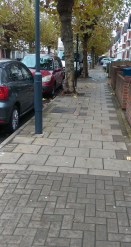
imag0217_burst004The Harrow council seems to be doing reasonably well in clearing leaves from the major roads but the side streets which are used more by residents and pose equal or more serious health and safety hazard are full of the leaves and need more than any scheduled clearance.
We have drawn the council attention to this concerning situation and presented a photo sample from a side street (photo: right).
It is good that the council took serious notice of our concern and the Harrow Pride team informed and cleaned the sampled street promptly (photo: left). But there are many other similar streets that require prompt action – we hope that the Council would find a slice of its shrinking budget for leaf clearance in the borough.

Once seat of learning, now an eyesore

imag0195Buckingham College in Hindes Road suddenly and mysteriously closed last year.
The school moved to this prime location in 1937 with 36 boys on the roll. Before closing, the student population of this private school was mostly Asian.
The independent education provider served pupils well before closing – the secondary school achieved high GCSE results like 79 per cent A* to C grades.
On our enquiry about the future of the site, Harrow council corporate director community Tom McCourt informed that “the site has now been purchased and planning permission has been granted for the redevelopment to provide a three and four storey building for twenty-nine retirement living units”.

Hall now relies on cheap personal attack

Irrespective of the flow of the Harrow cabinet meeting on 13 October 2016 and how the Tory opposition leader Cllr Hall feels about the council’s regeneration project scheme, her personal attack on the leader of the council Cllr Sachin Shah is unacceptable.
SSResponding to Cllr Hall’s comment about Cllr Sachin Shah taking his shoes off at the meeting and the way he was sitting, he explained ‘it was part of his upbringing to take his shoes off while sitting’ and asked for an apology from Cllr Hall but she refused in a tweet return.

SH D3This is not the first time that Cllr Hall’s conduct at a meeting has caused concerns, requiring a corrective action. For example, the Standards Assessment Sub-Committee in its meeting on 27 September 2011 suggested that “Councillor Hall may benefit from training in media and interpersonal training and training in holding voluntary groups and public bodies to account” – Decision Notice gov 008-039/ 442202 followed by

Harrow council’s agreed regeneration strategy can only be good as it addresses housing and community needs, including homes for private rent on Council land, new schools, a new Central Library and a new Civic Centre in Wealdstone.
But of course such exciting plans, paid off partly from capital receipts by the end of the development period, are not good enough for Cllr Hall who has been attacking the plans without offering any alternatives.
Further concern is that Cllr Hall’s intrinsic opposition to the regeneration plans is most probably because of her personal reasons.
Cllr Hall has a shop in Wealdstone and the area will form the hub of a wider package of regeneration initiatives which could initially have some unfavourable parking implications for the locality. There is a serious issue about Cllr Hall’s conflict of interest.
Cllr Hall is under the police investigation.
The council chief executive is enthusiastically leading the regeneration programme since his return to the post that was ‘unilaterally and wrongly’ deleted by Cllr Hall’s short-lived administration in late 2013, forcing the chief executive Michael Lockwood to go.
We hope that the council’s agreed decisions would be honoured by all members of the council in the interest of the residents, irrespective of personal reasons or the personality clashes.

Come clean Bob Blackman MP!

It can only be good that the electronic media provides more and better means for the public to know their elected representatives and hold them to account on matters like MP-specific income and expenses, and the use of their position.bb2
In Harrow, Harrow East constituency is well known for headlines concerning MP expenses. For example, regarding the present MP, the Mirror reported last year that Harrow East Tory MP Bob Blackman was ordered to repay more than £1,000 in wrongly-claimed mileage expenses.
Now there are concerns about the status of the fund-raising by the Bob Blackman MP ‘business club’. Seemingly there is no public information about the money raised – income and expenditure or banking – no statement of accounts at the constituency (HECA – Harrow East Conservative Association) or the Westminster level or at the MP’s website.
The well established club which regularly holds fund-raising events is a thriving money generator: for example, last year the Club organised a Diwali Dinner at Premier Banqueting in Wealdstone, attended by the then Mayor of London Boris Johnson and the Tory Mayoral candidate Zac Goldsmith as well as 300 paid participants. The event raised over £15,000.
Concerns are also about what influence, if any, was used by the MP Blackman to get his assistant selected as a candidate to contest from the Harrow’s Queensbury ward at the council election in 2018. The assistant Lakshmi Kaul is an Indian occupied Kashmir activist with no obvious interest in Queensbury.
The Harrow East Conservative Association, that nurtures the MP Blackman, selects the council candidates.
Note: Kashmir is a long-standing divide line between India and Pakistan relationships, needing a harmonious and sensitive approach by the global community to resolve the matter.
Most of us in Harrow are proud of our good communal relationships and would like to keep it this way, for example by leaving India and Pakistan situations at the appropriate international level rather than bringing it to Harrow by any political groups and stirring up emotions for political gains.

lk4
updated 19/10/2016

Politics of Bexit hitting schools

Following the EU referendum, the schools are caught up with the politics of Bexit by the implications of school census, immigration, migration and English as an Additional Language (EAL).
Many schools, including in Harrow, have started collecting data on pupils’ country of birth, nationality and level of English proficiency through the school census in line with the national population census, to fulfil the Department for Education requirement.
scensus“The information will be used to help the DfE better understand how children with, for example, English as an additional language, perform in terms of broader learning” informs DfE.
At present, schools record if a pupil speaks EAL or not, worked out on the basis of the language spoken at home rather than pupil’s acquisition of the English language – the information is usually gathered through the admission process where parents are asked “what language is spoken at home” rather than ‘what is the child’s first language’.
From September, schools will not only need to collect information about pupils ‘country of birth’ and the ‘nationality’ but also to assess each EAL pupil’s “proficiency level”, using a new five-point scale, which ranges from A at the bottom and E at the top. This will be passed to the government for analysis.
Each pupil will receive just one grade for their EAL level, combining their reading, written and spoken language proficiency.
The schools are not really trained or resourced to carry out this extensive and rather sensitive work.
Many feel that following Brexit, the government seemingly wants to highlight that there are not enough school places and there is increased demand on the school resources because a lot of foreigners live in the UK, to deflect from the fact that the state schools are not well resourced to start with.
Who knows how else the school census data would be used.
It is very concerning that the politics of immigration and language is hitting our schools in this way.