Harrow Labour hails victory as a Harrow school secures new ‘lollipop’ crossing guard after funding U-turn

Harrow Labour are celebrating a major win for road safety (Facebook page today), after Pinner Park Primary School appointed a new school crossing patrol – commonly known as a “Lollipop” guard – following a hard-fought campaign to protect funding for the service across the borough.
Earlier this year, Harrow’s Conservative administration was to cut £26,000 from the Highways Road Safety budget, a move that would have axed five crossing patrol posts. The proposal sparked widespread concern from parents, teachers, and residents, who warned it would put children at greater risk on Harrow’s busy roads.
In response, a petition titled “Save the ‘Lollipop’ School Crossing Patrol Service in Harrow” was launched and delivered to the council in February 2025. Campaigners highlighted the vital role crossing guards play in keeping children safe on their way to and from school. Between 2017 and 2020 alone, 41 children were hit by vehicles in Harrow, eight of them seriously, according to figures reported by London World.
Following mounting pressure, the Conservative administration made a U-turn soon after the proposal, confirming that the School Crossing Patrol Service would remain part of its Service Level Agreement with schools.
The decision has already had a positive impact, with Pinner Park Primary – one of the schools originally mentioned in the petition – now benefiting from a newly appointed crossing guard. Parents and commuters have welcomed the move, saying it brings peace of mind during the morning and afternoon rush.
“This would not have happened without the campaign and pressure from Harrow Labour councillors to support this service,” said Cllr Stephen Hickman, Labour’s shadow portfolio holder for children’s services.
“School crossing patrols save lives. Removing them would have forced children to cross dangerous roads on their own, and that is simply unacceptable.”
However, concerns remain that some junctions in Harrow are still poorly designed or unsafe, with residents calling for further investment in pedestrian safety.
As in much of England, school crossing patrols are a non-statutory service. This means councils are not legally required to provide them, leaving them vulnerable to future budget cuts.
After ‘inadequate’ children’s services, Harrow offers red tape instead of reform

Harrow Council has set out an action plan of procedural and structural reforms in response to Ofsted’s inadequate judgement of its children’s services and a subsequent Department for Education improvement notice. But critics warn the council has failed to tackle the deeper cultural and ethos challenges at the heart of the services.
Commentators argue that Harrow’s path to genuine improvement will require more than compliance systems and new structures. Instead, they say the focus must shift towards creating a culture of care, compassion, and partnership – where children, families, and staff feel valued, respected, and supported.
Key points for meaningful and lasting improvement include:
Co-producing a shared values framework with children, families, care leavers, and staff, ensuring all policies and standards are guided by the test: “Would this be good enough for my child?”
Leaders modelling care and compassion, moving away from a culture of “management by audit” to one of learning and encouragement.
Establishing feedback panels and real-time tools to capture the experiences of children and families, using this input to drive cultural change, not just service adjustments.
Embedding relationship-based social work, prioritising trust, empathy, and continuity, supported by restorative training for staff.
Investing in staff wellbeing programmes, celebrating success stories, and shifting towards a strengths-based approach for both staff and families.
Reframing supervision and training to highlight values, ethics, empathy, and cultural humility alongside statutory knowledge.
Broadening performance measures to capture children’s lived experiences, trust in staff, and sense of belonging – not just statutory timelines.
Advocates argue that without embedding these cultural reforms, Harrow risks repeating the cycle of compliance-driven change without securing the trust and confidence of children, families, and frontline workers.
The ease with which such a deficient action plan excelled through the Harrow council cabinet process raises serious concerns about oversight and scrutiny.

Northwick Park staff praised by patients as NHS Trust rankings published

With the release of national rankings naming England’s best and worst-performing NHS Trusts, Harrow residents are sharing their own experiences of Northwick Park Hospital – and many say the picture on the ground is more encouraging than the headlines suggest.
The new league tables, based on key metrics like A&E wait times, cancer care, elective surgery delays, and financial stability, placed London North West University Healthcare NHS Trust somewhere outside the top-performing tier.
The hospital under the Trust, which is relied upon by thousands of local families, has faced sustained pressure in recent years. Like other parts of the NHS, services are stretched, waiting times can be long, and demand on emergency care continues to grow. Yet patients report that the staff remain committed, approachable and compassionate.
One patient who recently attended A&E described how, despite the crowded waiting areas and busy atmosphere, “the doctors and nurses were cheerful, caring and reassuring.” Others have spoken of the professionalism and kindness shown by ward staff, even when under strain.
Community voices stress that while performance data is important, it does not always capture the quality of human care experienced day-to-day. “You feel they really want to help you,” said a Harrow resident, adding that this makes a real difference to people in stressful situations.
For many in Harrow, Northwick Park continues to be a trusted cornerstone of local healthcare. The dedication of its staff, patients say, deserves recognition alongside the statistics.

Harrow’s health prevention talk is cheap – Harrow needs action, not another paper exercise

Harrow’s Health and Wellbeing Board is to consider the report ‘The prevention approach for the Joint Health and Wellbeing Board’ –  but if residents were hoping for a bold action report, they’ll be left disappointed.
The paper is full of warm words about “systematic approaches” and “joint engagement,” but light on specifics. It promises everything from tackling childhood obesity to boosting economic wellbeing, yet offers no sense of priority, no concrete timelines, and no guarantee of resources. It’s a scattergun list, not a strategy.
We all know prevention is vital: keeping frail older people out of hospital, tackling the mental health crisis before it spills into A&E, supporting children early to break cycles of ill health. But without teeth – measurable targets, clear accountability, and actual investment – prevention remains nothing more than a buzzword.
The uncomfortable truth is this: health inequalities in Harrow are deepening now. Families are struggling now. Older residents are isolated now. Another round of “considering” and “discussing” does little to change that.
The report refers to the Harrow Joint Strategic Needs Assessment (JSNA), a subgroup of the board, that provides a life-course, ‘evidence-based’ profile of community needs, including inequalities, demographics, and health trends.
However, the JSNA lacks evaluation transparency, with no public evidence of whether its findings meaningfully inform health outcomes, commissioning decisions, or policy changes. It also offers no measurable impact tracking – functioning more as a descriptive document than an evaluative tool. There is little indication of how identified needs translate into tangible improvements or service redesign. Without published progress updates or accessible dashboards, the JSNA risks serving as a static reporting exercise rather than a dynamic instrument for ongoing planning and accountability.
Across Harrow, service performance issues – from Adult Social Care (“requires improvement”) to Children’s Services (“inadequate”) – point to structural challenges in delivery and oversight.
If the Board is serious, it must move from rhetoric to results. That means focusing on the biggest local risks, funding real interventions, and showing the public how progress will be measured. Prevention delayed is prevention denied – and Harrow deserves better than another glossy report gathering dust.
Hope the members of the board would not just rubber-stamp the ‘The prevention approach for the Joint Health and Wellbeing Board’ report.

Don’t let conservation divide Harrow

Since 2022 Conservative administration, Harrow Council has produced several Supplementary Planning Documents (SPDs) – including four* recent ones – that raise troubling questions about both process and purpose. Chief among them are doubts about the value of ‘consultation’ and the extent to which public input genuinely shaped the final policies.
These SPDs are highly technical documents, requiring specialist knowledge, which only makes the role of public engagement more uncertain.
[SPDs are non-statutory documents that provide detailed guidance on specific issues (e.g. design guides, affordable housing requirements, developer contributions) and sit beneath the Core Strategy, the statutory part of the Local Plan setting out long-term spatial planning policies]
Harrow rightly prides itself on being a borough of diversity, where many communities live side by side. Yet the council’s approach to Conservation Areas and Article 4 Directions risks undermining that unity. By issuing separate SPDs tailored to individual neighbourhoods, the council may be reinforcing social divides rather than safeguarding shared heritage.
Affluent areas are effectively protected as “heritage enclaves,” while deprived neighbourhoods risk being frozen in place, unable to evolve or improve. This is not conservation – it is entrenchment.
Planning policy should indeed preserve what is historically or architecturally significant. But it must also address the living needs of residents today and help improve their quality of life. Above all, it should close the gap between communities, not widen it. Queensbury, South Harrow, Rayners Lane and Wealdstone are no less important than Harrow Weald, Pinner or Stanmore.
The Tall Buildings SPD illustrates the problem. The document seems uncertain whether it wants to prohibit or cautiously encourage tall buildings but by implication the rules allow taller developments in areas that already have tall buildings, where denser suburbs are opened up to more high-rise construction – while the more affluent parts of the borough, where tall buildings are rare, are safeguarded from such change. The result is not balanced growth, but selective protection that privileges some neighbourhoods while overburdening others.
Viewed this way, ‘conservation’ begins to look less like heritage protection and more like division. Different rules for different postcodes risk locking in inequality rather than celebrating diversity. Worse still, they create the perception that the council has shifted to the right – stoking exclusion, favouring privilege, and overlooking the borough’s real social and cultural fabric.
When planning dictates different futures for different communities, the outcome is not conservation but segregation. Harrow needs a planning vision that builds a shared sense of place – one borough, one community – rather than a patchwork of privilege, neglect, and exclusion.
It is time to rethink Conservation Areas and Article 4. Harrow-on-the-Hill, Hatch End, and Stanmore deserve recognition, but so too do every other neighbourhood. No area should be set apart by special rules. True conservation should bring people together, not drive them apart.
* Conservation Areas and Article 4

Harrow’s hidden struggles: beyond the suburban façade

Harrow is often imagined as a leafy suburban borough on London’s edge, known for its green spaces and good schools. Yet behind that image lies a more complex reality: pockets of deprivation more commonly associated with inner-city life.
Harrow’s diversity* is often positively acknowledged, but less attention is given to the experiences of deprivation within it, which must also be recognised and supported.
More than half of Harrow’s households (51%) experience deprivation in at least one area, from poor health to overcrowded housing. The rates are even higher in wards such as Queensbury East (59.3%), Wealdstone South (59.2%), and South Harrow (57.9%).
Child poverty is a particularly pressing concern. Borough-wide, one in three children (33%) live in poverty after housing costs. In Roxbourne, the figure rises to 42%, leaving nearly half of children in financially precarious circumstances.
Residents report that support has not kept pace with demand. Food banks are seeing record visitor numbers, while the Harrow Baby Bank – run by local mothers and volunteers – struggles to meet rising requests for essentials. Mental health waiting lists continue to grow, leaving vulnerable residents without timely help.
Local leadership and charities are stepping in with targeted initiatives, though campaigners warn that pockets of initiatives through the pockets of funding make coordination difficult.
Through the Household Support Fund, Harrow Council received £1.47 million from the Department for Work and Pensions. The funding supported Free School Meal vouchers, emergency financial aid, and crisis schemes – vital lifelines for families grappling with inflation and insecure incomes.
In April 2025, the council also secured nearly £800,000 to improve libraries, expand employment and training programmes, and upgrade arts facilities. These investments highlight that tackling deprivation means not only addressing food and housing, but also supporting opportunity and community wellbeing.
Campaigners argue that piecemeal funding cannot close the gap alone. They are calling for long-term investment in affordable housing, youth services, and mental health provision, alongside stronger coordination between the council, voluntary sector, and grassroot organisations.
Harrow may sit on the edge of London, but many of its challenges mirror those of the capital’s inner-city boroughs. The task now is ensuring that its most vulnerable residents are not left behind.
* [White 36.5% and non-White 63.5%, including 45.2% Asian heritage (2021 Census); 92.0% non-White pupils in Harrow schools (as of January 2023 according to the Harrow council report)]. 

Labour’s centralised control over local democracy

Recent events in Brent – where some incumbent Labour councillors reportedly weren’t reselected for the 2026 elections (Wembley Matters) as the selections were made by the London region of the Labour Party and not the local Labour members – signal a troubling trend: local voices being sidelined by national gatekeepers. This not only erodes the goodwill of grassroots activists but also contributes to a growing sense of disenfranchisement.
The practice in Brent is not an isolated anomaly – but part of an emerging Labour pattern. Leicester, Bristol, Kirklees, and Sefton have all shown how national-level oversight, when misused, can fracture local democracies.
If Labour doesn’t recalibrate, it risks further erosion of trust – and the local electoral ground it needs for 2026 and beyond.
For the 2023 Leicester City Council election, the Labour National Executive Committee (NEC) intervened directly due to internal strife, overseeing candidate selections. The result: 19 sitting councillors were deselected. Shockingly, 58% of deselected councillors were from BAME backgrounds compared to just 18% of white councillors – raising serious concerns about equity and representation. (Wikipedia).
Ahead of the 2021 Bristol City Council election, Labour’s candidate selection was managed not locally but by paid officials from the South West Labour Party’s regional office. This move, replacing local oversight, led to banned candidates and resignations among activists frustrated by the top-down approach. (ibid)
Central meddling isn’t confined to deselections – it reverberates. In Merseyside’s Sefton Council, multiple resignations occurred as councillors objected to policy directions and handling of national issues, such as the war in Gaza. (ibid)
In Kirklees, defeats and internal tensions led to mass resignations and defections to independent groups, diminishing local Labour control and further fragmenting governance. (ibid)
For a healthy local democracy, the central political party’s role should be supportive, not authoritarian.

Harrow council under fire despite big spending pledges

Harrow council – controlled by the Conservatives after bucking London’s Labour wave in 2022 – is facing mounting criticism over failing services, even as it unveils major new investments.
The borough has committed £42 million over three years to upgrade roads and pavements, alongside a £900,000 boost for street cleansing and a £6 million injection into parks, aiming to lift the number of Green Flag-accredited sites from six to nine by 2026. Free one-hour parking has also been rolled out to support local businesses.
But serious concerns overshadow these achievements. Ofsted branded Children’s Services “Inadequate,” citing poor support for care leavers and DfE improvement notice issued to the council, while the Care Quality Commission rated Adult Social Care as “Requires Improvement” amid long delays, digital access barriers, and reliance on zero-hours contracts.
Residents have also reported years-long waits for housing repairs, with some cases affecting children’s health.
Meanwhile, weak financial oversight – linked to repeated project delays and problems with the Dynamics 365 system – has eroded public trust.
While some planning documents are updated, local feedback further criticises rigid planning processes and inconsistent street maintenance, fuelling frustration that progress around the town centre has not been matched across the borough.
Harrow council also faces sharp criticism over systemic failures exposed by Ombudsman. Their findings reveal a council dangerously out of step with its responsibilities – particularly towards its most vulnerable residents.
Read: more and more complaints against the council being externally upheld
Analysts note the political stakes are high: Harrow is the only London borough the Conservatives wrested from Labour in 2022 – well calculated support from sections of the British Indian community in Harrow East played a pivotal role in winning some wards, and therefore the council *(1).
Residents and campaigners are now demanding urgent, transparent reforms to restore confidence in services – warning that the council risks losing hard-won support if it cannot deliver, especially as voters would have wider choice in 2026 council elections.
Read: New Political Party ‘Arise’ Launched in Harrow
As well as, demanding a public review of Ombudsman findings, concrete reforms, especially in care-home governance, housing repairs, and complaint follow-up. Also, greater transparency and communication from the council when decisions affect vulnerable groups.
The council administration must place residents at the centre of its decision-making and take decisive steps to restore public confidence in the council services, rather than deflecting concerns by appealing to nationalist sentiment.
*(1)

New Political Party ‘Arise’ Launched in Harrow

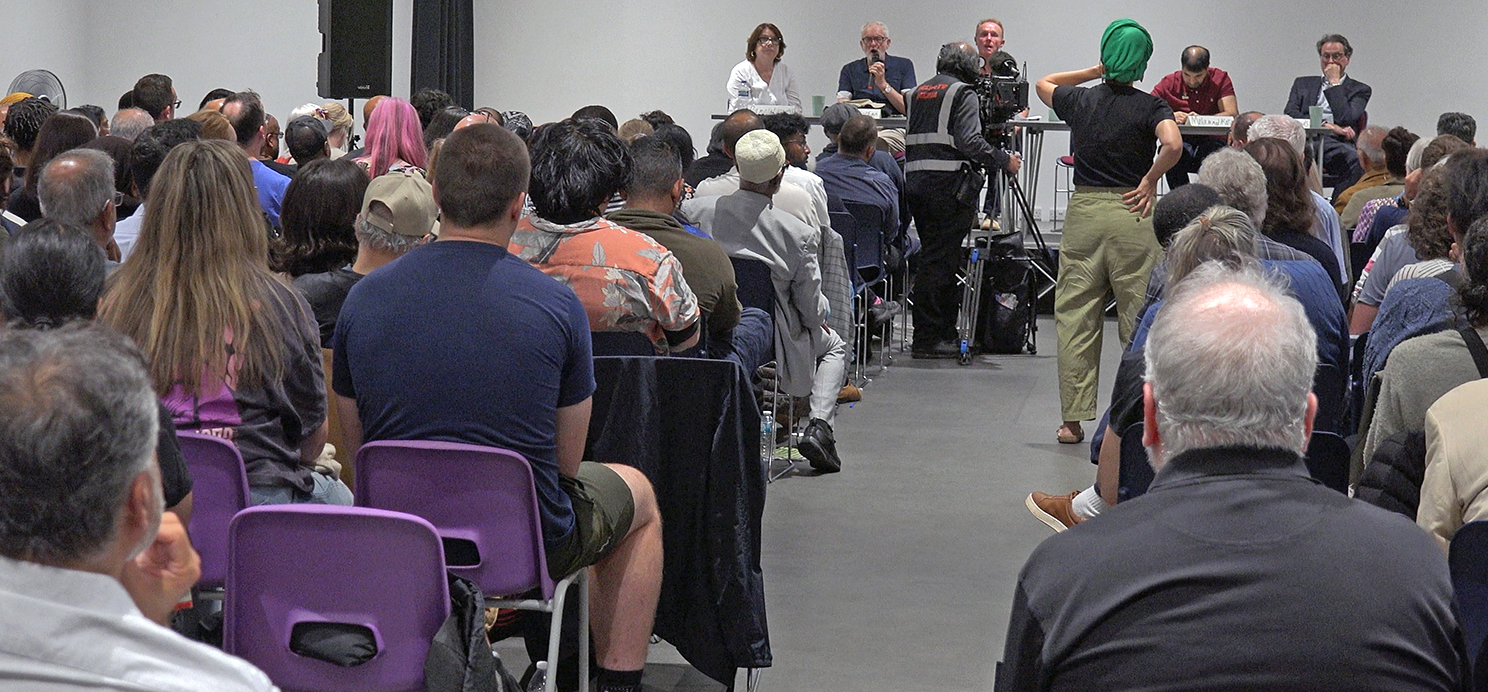
A new local political party, Arise, has been launched in Harrow, aiming to give residents an alternative voice ahead of the 2026 local council elections, and to hold the local politicians to account.
The party was formally introduced on 27 August at a community gathering led by Pamela Fitzpatrick, director of Jeremy Corbyn’s Peace and Justice Project, former Harrow councillor and parliamentary candidate.
The movement has been founded by local campaigners and residents under the slogan “we deserve better.”
Fitzpatrick said the party was born out of frustration with both main parties, arguing: “Now is the time that we come together, and we get a change in Harrow because whether it’s Tory or Labour, we really haven’t seen any improvement in Harrow.”
Explaining its distinct role, Fitzpatrick noted that Arise will remain a local initiative, though it is expected to eventually fold into a new national party being developed by Jeremy Corbyn. She emphasised the grassroots spirit of the project, remarking: “Your Party is going to be a new national party, but it’s not a party yet… How grassroots are we in Harrow? We’re very grassroots.”
As it’s likely that Arise would fold into the national party, Jeremy Corbyn focused on the national party priorities:He stressed that the party’s vision is grounded in tackling inequality, child poverty, insecure work, and discrimination. He highlighted the need for every child to have access to food, education, and equal opportunities, and called for policies that put people’s lives at the centre.
On foreign policy, Corbyn condemned the war in Ukraine and the ongoing conflict in Gaza, describing the situation there as genocide. He urged the UK government to immediately recognise a Palestinian state, halt arms sales to Israel, and impose sanctions.
Corbyn also questioned Britain’s rising defence expenditure, nuclear weapons policy, and involvement in what he described as a “global arms race,” instead advocating for disarmament and peace.
Summarising the new movement’s principles, Corbyn said it would campaign for “poverty, equality and justice in our society, environmental sustainability, public ownership and opposition to wars.”
He concluded with a message of unity, insisting that the party aims to be a source of hope: “Our movement, our party, our organisation will bring people together… Unity is what we need, and unity is what will win.”

Harrow Conservative administration largely shows disregard for some people, so it looks!

Harrow Council’s Conservative administration is facing mounting outrage after yet another wave of damning rulings from the Local Government and Social Care Ombudsman (LGO), the courts, and regulators.
Critics say the council has shown a long-standing disregard for some of its most vulnerable residents – from disabled children and adults to struggling families in unsuitable housing.
The failures are not new. Since at least the mid-2000s, Harrow’s Conservative administration has been repeatedly found guilty of maladministration, unlawful decision-making, and outright neglect of duty. High-profile cases included unlawful cuts to adult care services in 2007 and compensation orders over botched school mergers in 2009.
Fast-forward to today, and the pattern has only worsened.
In August 2025, the LGO found Harrow Council had forced a registered blind man and his family to endure avoidable years in unsuitable housing, awarding them over £6,000 in compensation.
In July 2025, the Ombudsman ruled the council failed to follow procedure over a disabled child’s respite care, despite repeated reminders.
In April 2025, Ofsted rated the council’s children’s services “inadequate,” prompting the Department for Education to slap Harrow with an official improvement notice.
In June 2023, Harrow Council was compelled by a court to provide suitable housing for a family with a severely disabled child who had been in unsuitable temporary accommodation for almost a year.
Between 2023 and 2024, case after case revealed missed special educational needs provision, delays to legally required education plans, botched care assessments, and unsafe housing conditions, including 3,500 uninspected homes with outstanding electrical safety risks.
The administration that gives a sense of being more on the right has often responded defensively, portraying its governance as part of a broader ‘reassurance that Harrow belongs in Britain’ – but residents say this rhetoric masks systemic neglect and calculated disregard for those without political power.
Local campaigners argue the council’s priorities are clear: political messaging first, people last. Vulnerable residents are left waiting months, even years, for the services and support they are legally entitled to. Families are routinely offered token compensation while systemic failures go unaddressed.
As one critic put it, ‘What happens in macro, happens in micro’ – Harrow council Conservative administration reflects its party that seems more interested in political positioning nearing Reform UK than in caring for ordinary people.
With watchdogs continuing to expose failure after failure, pressure is growing for accountability. But so far, Harrow’s Conservative administration appears more concerned with damage control than genuine reform.