Academisation

While most of the state secondary schools in Harrow now have academy status, a vast majority of primary schools have not.
academiesWe hear concerns about the government plans to turn every state school in England into an academy – many teachers from Harrow were at the recent academy protest in London and of course at the teachers conference that has demonstrated strong opposition to total academisation.
Academies are independent, state-funded schools, which receive their funding directly from central government, rather than through a local authority. They are overseen by the charitable academy trusts which are mostly not local and are not well monitored – scandal at an academy chain is an eye opener!
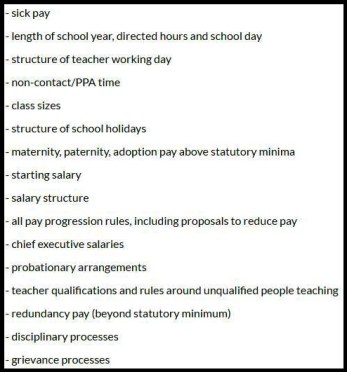
In pointing out total abolition of national pay and conditions under academy status, Christine Blower, general secretary NUT, has listed some (photo).
Teachers also voted to opt out of the of Prevent duty for schools, developed due to the rift between the education and home secretaries at the time as who is not doing enough about ‘..isms’.
Considering the failures in experimenting the education models and modes, it is about time to listen to the education practitioners regarding what is taught, how and where it is taught.


Hall in breach of councillor’s code of conduct?

With reference to the council’s planned regeneration of Wealdstone, Cllr Hall, reportedly said: “This (Premier Banqueting) is a very important business, this will be harmful to a lot of people who work for that business. This is their business, their livelihood put on the line here. She said Premier Banqueting, in Canning Road, employs about 120 people, most of whom are Harrow residents”.SH D3
We leave it to the council to determine whether Cllr Hall breached the councillors code of conduct by not safeguarding the financial interest of the council as her public statement potentially enhances the Premier Banqueting’s and diminishes the Harrow council’s negotiating powers in a possibly active contractual deal for the council to acquire the Premier Banqueting, paid by the public money.
Furthermore, the council could finish up paying far more if the owner of the Banqueting hall gets fed up by less assuring political situation at the council and sells the venue to someone else, and the council finish up paying far more to the new owner than the current negotiated price.
Cllr Hall also presented the petition ‘Don’t Force Communities out of Wealdstone’ at the Council meeting on 25 February 2016 which says: ‘Council has announced plans for a new Civic Centre in Wealdstone, which could force out a community banqueting hall, a local temple and undermine local businesses by closing the Peel House car park … putting these popular and valued community assets at risk would be a major loss to Wealdstone and its local economy’.
Cllr Hall said: “It will damage the entire Wealdstone business community”.
The petition was debated at the meeting but Cllr Hall who has a shop in Wealdstone did not declare a pecuniary interest and remained present during the debate.
Again we leave it to the authorities to act as non declaration of pecuniary interest potentially involves the commission of a criminal offence.

Ongoing concerns about the potential lack of transparency at Harrow CCG!

While the Harrow West MP (Lab) is worried that the walk-in centres at Alexandra Avenue and the Pinn Medical Centre could be handed to a private company because of the government’s new rules, Mr Thomas has taken no notice of the local concerns about the shaky confidence in and potential conflict of interest at the Harrow Clinical Commissioning Group.CCG2

Mr Thomas might have a political score but the local walk in centres are in no real danger of taken over by outside bidders as the key GP partners in the surgeries running these centres are likely to bid and win with the addition of New Harrow East walk in centre. All these high profile key players – Dr Amol Kelshiker (The Pinn Medical Centre), Dr Genevieve Small (Ridgeway / Alexandra Avenue Surgery), Dr Kanesh Rajani (Streatfield Health Centre) – are senior members of the Harrow CCG governing body.
On the other hand the position of the GPs owned Community Interest Company (transformed from the Harrow health Ltd) which has limitations on how much profit can be distributed, seems to be played down and is not likely to be used as a local serious bidder.
Such is the upper hand of the HCCG, that it seems to be involved in the board election for the independent Community Interest Company/Harrow health Ltd where each practice’s vote will form the number of points based on its patient list size – the election results are point based. Pinn has the highest number of registered patients with the Ridgeway Surgery in third place. Conflict of interest?
Good that the walk in centres provide primary care services 365 days a year, but there are implications, especially where the care services are channelled in a certain direction on the basis of more patients more funds flow their way, because of which majority of the other GP practices will lose funds as these would be siphoned off to the three walk in centres in Harrow.
There are also concerns about the loss of the continuity of care – for example, the GP practice which has tried not to issue the antibiotic unnecessarily, loses the battle as the walk in centre doctor could readily prescribe it.

Blackman voted to take £30 per week off a disabled person

bb2Harrow East Tory MP Bob Blackman voted for the cut as the House of Lords has been unable to stop a planned £30-a-week cut to disability benefits forced through by Government MPs.

The cut will see people receiving Employment and Support Allowance go from claiming £103-a-week to £73-a-week, and will affect people who are deemed currently unable to work but are capable of trying to find employment.
More than half a million disabled people could lose out as a result of further changes over the next four years to welfare payments as the formula the government uses to calculate the daily living component of Personal Independence Payment (PIP) for disabled people will change – BBC reports.
cutsThe public protests warn that the “cumulative effects” of cuts to both benefits and social care is eroding the capacity for some disabled people to live independently.
Bob Blackman has previously generally voted against laws to promote equality and human rights, and has voted to repeal the Human Rights Act 1998.
While he voted for pinching money from the vulnerable, Bob Blackman’s claim for expenses have been highly controversial.
His last year’s expenses £172,353.95, included £142,486.90 on staffing of which £35,000-£40,000 was the salary for his wife, his office manager of unknown formal qualification for the post. The other £25,885.20 included is for renting office space at the Harrow East Conservative Association office – the same HECA then financially supports the constituency’s political activities from the income.
An investigation by the Independent Parliamentary Standards Authority (Ipsa) found that the Harrow East MP submitted more than 700 “inaccurate” claims, amounting to more than £1000.

Financial crisis in social care sector

Nationally, nearly half of social care services inspected by the Care Quality Commission in the past year were found to be failing the frail and vulnerable, in what relatives and experts say is a symptom of the growing financial crisis in the sector.
There is also growing evidence of the crisis having an effect on the health system as in some cases hospital beds were being occupied by patients who could not leave because there was a lack of social care in place to support them.
In Harrow, of the 47 regulated providers inspected by CQC as at November 2015, none had received an outstanding rating overall, 35 received a rating of good, and 10 were rated as requires improvement and 2 received a rating of inadequate – requiring improvement and being inadequate are the failing categories.
Harrow specific number of allegations of abuse of people using social care services has increased, reported by us previously.
Quality of the care has co-relation with how well people in the social care are paid.
From the CQC data, as at December 2015, there were an estimated 150 establishments and 5,500 jobs in adult social care in Harrow, around 3,700 of these jobs were care workers and there were 86 registered managers in post.
As at December 2015, the average hourly rate across Harrow for a care worker was £7.61, including the independent sector average £7.50, which was less than the regional average across the London area (£8.00).
Furthermore, across Harrow, around 89% of care workers were aged 25 or over and 32% of these had an hourly rate less than £7.20.
Across the sector, 12.3% of care worker roles in Harrow were vacant as at December 2015 – equates to an estimated 450 vacancies.
Harrow assistant director of social services Chris Greenway has previously assured, “we have developed a Residential and Nursing Care Quality Charter, which reflects the views of people that have used Care Homes and their families to identify what a Good home should look like”.

Intriguing politics of Whitchurch playing fields!

Full credit goes to the Harrow East Tory party for their part in systematically securing this site for the Hindu secondary school.
In 2012, Labour run council decided to make the Whitchurch Consortium its preferred bidder for the tender to take over the lease and to redevelop the Whitchurch Pavilion and Playing Fields, saying that “our residents deserve excellent sports facilities”.
Soon after this decision, an opposition campaigned was encouraged by the Harrow East Conservatives, arguing that the issue is a ‘political matter’ in the constituency and charging the foot-soldiers to believe that the land needs to be developed for ‘sports for the community with proper facilities’.
Interesting that this was also the time when the Avanti School trust, led by an executive who attended Harrow East Conservatives fund-raising events, was looking for a suitable site like this for their Hindu secondary school.
WCPFHowever, the leading campaigners at the time believed that “We want to save a beautiful part of this green and pleasant land for all the people of the borough”, perhaps not being aware of a possible process to have a pre-determined outcome here.

People living in Stanmore and Edgware were asked to “make noise” by lobbying the Labour administration and council officers, including chief executive, and persuade them to re-think the matters.
A letter described the atmosphere at a cabinet meeting (Tories had no respect for public): “due to the constant barrage of heckling and abuse from the Conservative shadow cabinet towards public questioners and portfolio holders … made it almost impossible for members of the public, such as myself, to hear what the main areas of contention are around issues such as the re-development of Whitchurch Playing Fields”.
In late 2013 and before May 2014 council election when the controversial short-lived Cllr Hall administration  was working hard to retain the fluked control of the council, things moved fast as the local Avanti House formally showed  interest in building a new school building on the site which also provided an opportunity for Tory group leader to recover from her previous controversial* position about the location of the Hindu school in the borough.
To help the situation, Harrow East Tory MP Bob Blackman brought up the issue of the future of Whitchurch Playing Fields in a Westminster Hall debate, probably to increase his share of votes at the general election in 2015.
Minister for schools announced a feasibility study into the suitably of playing fields for a new school and completed it in favour of the Hindu school. The Education Funding Agency gave approval for the Avanti School trust to build the Hindu school at the Whitchurch playing fields. Subsequently, the arrangements for the lease of the site to the school trust were agreed under the Tory administration which was badly defeated in the 2014 council election.
February 2016: the Labour council granted planning permission for the Hindu secondary school to build a permanent new home at the playing fields despite being contrary to the site’s allocated purpose, seemingly as the main political parties calculated the level of support for their respective candidates at the London elections and could not afford a backlash from those concerned.
While we wish the Hindu school well, we don’t quite know what to say to the innocent previous ‘campaigners’ who were cleverly used in a highly political move and motivated by the fear that this redevelopment could cause problems such as the heavy traffic and the potential for undue noise and disturbance to those living nearby. Similarly, we don’t know what to say to the present objectors in minority.
SH D3* Observer Letters (Tory should say sorry to parents): “In one breath she welcomes the government’s support for the second Hindu school in the entire country and than, in the very next breath, she implies ‘not in my back yard’ … I feel Cllr Hall should apologise to the Indian community for her ill-disguised disapproval of their aspirations for a school for their children“.

Hidden charges in care homes

Citizen Advice’s recent research report on the hidden charges alerts that older people living in care homes risk getting a poor deal for a variety of reasons.
They may have physical or mental health conditions which limit their ability to advocate for their own interests.
Some care homes give extremely short notice periods for fee increases, fail to pass on savings, and may be profiting when residents are away for extended periods of time, for instance, when in hospital, the report points out.
Key charges, such as carer assistance and chiropody, are often hard to discover before moving into a care home and can be very expensive.
handsCommenting on the report which says that a number of local authorities are still struggling to ensure people have access to affordable care home options despite new statutory requirements, Harrow assistant director of social services Chris Greenway assured that Harrow is much ahead of such authorities.
We have developed the current My Community ePurse system that has links to information on every care home in the Borough and throughout North West London and their Care Quality Commission ratings, Mr Greenway informed.
“We also have a set of 8 minimum standards for entry into our marketplace that includes some of the issues around fees and charges, quality and employment of staff. Moreover, we have developed a Residential and Nursing Care Quality Charter, which reflects the views of people that have used Care Homes and their families to identify what a Good home should look like” added Mr Greenway.

Regeneration challenges

Regeneration logoHarrow stands on the brink of its biggest regeneration opportunity in decades and needs wider support to deliver the programme in a borough that has diverse population and different but equally important social, cultural and religious aspirations.
The following regeneration picture emerges from the information sent to us by the council:
Several short and long term projects, including the Station Road Quarter for the borough over the next 5-7 years, containing a variety of new homes, a new primary school and spaces for small and medium enterprises – also a new public realm and landscape, leading to a new civic square opposite Harrow Mosque, a new street to Harrow and Wealdstone Station and improved approach to the Station Road flyover to Wealdstone.
The transformation in Wealdstone is on its way with securing £1.5m from the Mayor’s London Regeneration Fund to support the creation of new jobs, work spaces for businesses and fund a new public square – relocation of the civic centre to Wealdstone and possibly acquiring the Premier Banqueting hall, could help to develop the area further with better business opportunities as well as increased health care and leisure facilities.
The 3Fox International is hired to publicise the programme through BIG Harrow Campaign, the BIG Magazine and a regeneration specific website.

Challenges
The regeneration programme is taking place at the time when austerity measures are biting and the council budget is contracting.
Obstructive opposition at the council – no expressed commitment to the projects now or in future if they ever gained council administration.
How best to engage with the communities or inform them about the opportunities that the regeneration programme offers – 3Fox International might access the investors and developers well through its conventional mode of communication (hard to recognise Harrow through the 3Fox printed or digital material) but not sure about them accessing Harrow’s diverse population as they appear to have no obvious track record of penetrating the communities in areas like Harrow and seem to have only one BME member in their team.
The in house ‘harrow residents panel’ is too limited to have an on-going dialogue with the community about the borough’s regeneration programme given the huge diversity that Harrow Ambition 2020 plan asserts.
One of the council’s corporate objectives is, ‘making a difference for communities – for example by promoting social engagement and a sense of community respect, belonging and identity’ – not sure how this informs the regeneration programme – no evidence of mapping the priority across the programme.

‘Our approach is now much more business-like’, claims the council

Nice to hear that the council has a ‘business-like’ approach (page 32 of the 1,568 pages reports before the cabinet meeting tomorrow)!
Surely this means that the ‘going concern’ has well established structure where the chief executive sits between the council Members and the staff as a key adviser to the former and a leader of the latter.
While the relationship between the chief executive and all Members is pivotal for good governance, in Harrow the leader of the opposition (photo) considered this post redundant and has not really welcomed the chief executive’s return to Harrow.
In the ‘business-like’ approach, the chief executive has achieved appropriate staffing structure and could get best out of them through the demanding leadership, but he has no control on the quality of the Members.
For example, no obvious demand by the Members for a well defined and consolidated council’s business model rather than having scattered statements in the 1,568 pages cabinet reports about the council’s growth, where it will go for funding and how to build a sustainable income stream etc.SH D3
Such is the situation that out of 24 point-scoring cabinet questions by the opposition councillors tomorrow, one asks for ‘the business/financial case of the senior management restructure’ but no sense to ask for the business case in view of the council’s claimed ‘business-like’ approach.
Another question asks what different skills the officers need for the successful delivery of the projects due to the increased focus on commercialisation in the Budget – he fails to ask the same question about the skills of the Members who are to have an eye on building for the future, as much as addressing the immediate needs.

Scrutiny – illusive!

Our local democracy has its dullest moments when long-worded council reports, not always giving an accurate* picture and costing the residents a fortune, are internally scrutinised in the overview and scrutiny committee meetings, a sort of political arena, generating more paper work.
Occasionally the environment becomes somewhat entertaining when the chief officer and leader of the council are tackled by the councillors, mostly the opposition councillors.
Following is such a scene from a meeting in January 2016 – we have added questions to suggest how the answers could have been followed through in a meaningful scrutiny:
How are the council engaging residents on its Regeneration proposals?
The Leader: the council had introduced a Residents Regeneration Panel that has generated good discussions on general issues relating to place shaping – (who has evaluated the process to really involve all residents?).
The Council has secured funding for the regeneration of Wealdstone. What specific projects will take place?
The Leader: money was being spent on creating a housing zone, helping business start up in Wealdstone and further investment in public realm. It was important to recognise that Wealdstone was one of the most deprived areas in Harrow and required investment – (meat on the bones?)
The average price of purchasing a house in Harrow is now £500k. How can nurses, social workers etc. afford to live in Harrow and what progress is being made on building more affordable homes in Harrow? (affordable housing is a key issue in the forthcoming London elections!)
Response: the regeneration project for Harrow would generate thousands of new homes (level of support and cooperation by the Harrow opposition?)
The cap on care which was introduced by the Care Act has now been pushed back to 2020. However to provide the implementation funding for it to be put into social care. Has any response been received by the Council?
ML2The Chief Executive: nationally the ageing population and adult social care cost added £700 million worth of cost to Local Government every year. Better joined up working was required in providing health and social care to achieve the best outcomes for residents – (Citizen Advice’s research report ‘Hidden charges in care homes’ found that older people living in care homes risk getting a poor deal for a variety of reasons and that the delay in implementing rest of the Care Act, access to affordable care home options as well as lack of certainty about care funding makes it all the more important that robust consumer protections are in place – what is the Harrow situation?)
*Over statement: “Schools in Harrow performed exceptionally well and did not by definition have an underperforming school” – p11: Minutes of the Overview and Scrutiny Committee on 17 November 2015
In 2015, several state funded primary schools were below and some well below the local and national % achieving level 4 or above in reading, writing and maths.
In 2015, some state funded secondary schools/ academies were below and one well below the local and national % achieving 5+ A*-C GCSEs (or equivalent) including English and maths GCSEs.
In 2015, no state funded secondary schools/ academies were in the top 100 GCSE results table.
In 2015, no state funded secondary schools/ academies were in the Top 100 A-level results table.
In 2015, in A-level average points score per subject, a number of state funded school/ academies were below the C grade – on average Harrow being in grade C, was lower than Barnet, Brent and Hillingdon which were C+.