‘Our approach is now much more business-like’, claims the council

Nice to hear that the council has a ‘business-like’ approach (page 32 of the 1,568 pages reports before the cabinet meeting tomorrow)!
Surely this means that the ‘going concern’ has well established structure where the chief executive sits between the council Members and the staff as a key adviser to the former and a leader of the latter.
While the relationship between the chief executive and all Members is pivotal for good governance, in Harrow the leader of the opposition (photo) considered this post redundant and has not really welcomed the chief executive’s return to Harrow.
In the ‘business-like’ approach, the chief executive has achieved appropriate staffing structure and could get best out of them through the demanding leadership, but he has no control on the quality of the Members.
For example, no obvious demand by the Members for a well defined and consolidated council’s business model rather than having scattered statements in the 1,568 pages cabinet reports about the council’s growth, where it will go for funding and how to build a sustainable income stream etc.SH D3
Such is the situation that out of 24 point-scoring cabinet questions by the opposition councillors tomorrow, one asks for ‘the business/financial case of the senior management restructure’ but no sense to ask for the business case in view of the council’s claimed ‘business-like’ approach.
Another question asks what different skills the officers need for the successful delivery of the projects due to the increased focus on commercialisation in the Budget – he fails to ask the same question about the skills of the Members who are to have an eye on building for the future, as much as addressing the immediate needs.

Scrutiny – illusive!

Our local democracy has its dullest moments when long-worded council reports, not always giving an accurate* picture and costing the residents a fortune, are internally scrutinised in the overview and scrutiny committee meetings, a sort of political arena, generating more paper work.
Occasionally the environment becomes somewhat entertaining when the chief officer and leader of the council are tackled by the councillors, mostly the opposition councillors.
Following is such a scene from a meeting in January 2016 – we have added questions to suggest how the answers could have been followed through in a meaningful scrutiny:
How are the council engaging residents on its Regeneration proposals?
The Leader: the council had introduced a Residents Regeneration Panel that has generated good discussions on general issues relating to place shaping – (who has evaluated the process to really involve all residents?).
The Council has secured funding for the regeneration of Wealdstone. What specific projects will take place?
The Leader: money was being spent on creating a housing zone, helping business start up in Wealdstone and further investment in public realm. It was important to recognise that Wealdstone was one of the most deprived areas in Harrow and required investment – (meat on the bones?)
The average price of purchasing a house in Harrow is now £500k. How can nurses, social workers etc. afford to live in Harrow and what progress is being made on building more affordable homes in Harrow? (affordable housing is a key issue in the forthcoming London elections!)
Response: the regeneration project for Harrow would generate thousands of new homes (level of support and cooperation by the Harrow opposition?)
The cap on care which was introduced by the Care Act has now been pushed back to 2020. However to provide the implementation funding for it to be put into social care. Has any response been received by the Council?
ML2The Chief Executive: nationally the ageing population and adult social care cost added £700 million worth of cost to Local Government every year. Better joined up working was required in providing health and social care to achieve the best outcomes for residents – (Citizen Advice’s research report ‘Hidden charges in care homes’ found that older people living in care homes risk getting a poor deal for a variety of reasons and that the delay in implementing rest of the Care Act, access to affordable care home options as well as lack of certainty about care funding makes it all the more important that robust consumer protections are in place – what is the Harrow situation?)
*Over statement: “Schools in Harrow performed exceptionally well and did not by definition have an underperforming school” – p11: Minutes of the Overview and Scrutiny Committee on 17 November 2015
In 2015, several state funded primary schools were below and some well below the local and national % achieving level 4 or above in reading, writing and maths.
In 2015, some state funded secondary schools/ academies were below and one well below the local and national % achieving 5+ A*-C GCSEs (or equivalent) including English and maths GCSEs.
In 2015, no state funded secondary schools/ academies were in the top 100 GCSE results table.
In 2015, no state funded secondary schools/ academies were in the Top 100 A-level results table.
In 2015, in A-level average points score per subject, a number of state funded school/ academies were below the C grade – on average Harrow being in grade C, was lower than Barnet, Brent and Hillingdon which were C+.

Protect local democracy

The government is consulting about proposed changes to the way local authorities in England and Wales invest their members’ pension funds which many say is to block local authorities from making ethical investment decisions relating to the arms trade. The consultation ends on 19 February.
These changes would allow central government to block ethical investment decisions made by democratically elected authorities like Harrow which is in close proximity of at least 13 weapon producers, military suppliers, and the surveillance and security industry, including Babcock International Group, Esterline, Iveco and Ultra Electronics.
More specific concern is that the proposed guidance would bar local authorities from practising ethical investments that reflect the values and opinions of local communities who want to ensure that their council is not supporting companies with proven records of doing harm to the environment, health and human rights nationally or internationally.
The Conservative Party’s reported press release announcing the changes explicitly said it was to prevent campaigns “against UK defence companies”, but the legislation could have far wider implications, for example blocking ethical investment decisions related to other human rights issues or climate change.
We take that the Harrow council that has adopted ‘fair trade’ principles, has forcefully opposed government proposal to grant the Secretary of State the power to intervene in local authorities investment decisions which tantamount to undermine the rights/ choices of pension fund members.

Flying caddies!

Flying binsWe heard concerns and expressed these about the quality of the recently introduced caddies.
Now there are further concerns about these flying all over the place after being emptied because of the strong gusty winds this year. This poses serious safety hazard, especially when they finish up in the streets/ roads and could cause serious vehicle accident.
In many cases the caddies are not removed from the streets for hours as the respective residents are not around.
Wonder if the caddy designers/ manufacturers did full risk assessment, including the impact of the weather conditions on these lightweight caddies when used outside, considering how these could be handled and left behind by the bin collectors in a rush.
Hope the council would review the caddy design – perhaps a reinforced base to make it more stable under windy conditions – and issue guidance for the residents how best to store these outside to avoid these blown by strong winds as well as to instruct the bin collectors to take good care about how/ where these are left after being emptied.

Saving Harrow Arts Centre not good enough for Tory opposition

Members of public clap at cabinet decision to continue looking for funding to save arts centre, but @HAConservatives don’t join in.
— Sachin Shah (@SachRShah) January 20, 2016
Harrow council cabinet has decided for the Cultura London, an independent charitable trust, to raise funds to redevelop the arts centre that is facing closure as the council can no longer afford to subsidise it.
The modernisation of the centre into ‘Southbank Centre for North London’ , is to include building a cinema, galleries, cafes, bars and better theatre facilities.
HAC2“From a backdrop of despondency, an opportunity to create an astonishing cultural future for Harrow has shone through. Culture is part of Harrow’s DNA” said Sandra Bruce-Gordon, Interim Chief Executive of Cultura London.

“It is fair to say that Harrow Arts Centre has a chequered history; despite the good will of the community and the aspirations of some to rebuild a theatre for Harrow, this was never realised. Our research says the time is now right to fulfil the vision of generations and once and for all address the issues of a cultural venue for Harrow and West London that is fit for purpose with the potential to be self-sustaining.” SH D3
However, the Tory opposition group, known for its ‘Punch and Judy’ attitude under councillor Hall’s ‘vindictive’ leadership, is hostile to the arrangements, in line with their opposition to the council’s imaginative regeneration programme for the borough.
Cllr Hall calls the initiative to save the arts centre as a “tragic irony”, unconvincingly claiming that residents have contacted her expressing concerns.

Gang and youth violence in Harrow?

voilenceUnder the Home Secretary’s drive, her minister Karen Bradley MP, responsible for dealing with various problems associated with the diversity, informs providing support for areas including Harrow that will allow the police and authorities to deal with the local gang and youth violence – a positive reflection on the government before the London elections.
Whether there is such a serious problem in Harrow or it is a perceived problem because of the presence of certain people on our streets, the point of interest is the scope of the ‘support’ which Harrow is thrilled about.
In other areas where such a support has been provided, it is more to deal with the ‘effects’ through police action and receiving support from experts to better understand the nature of the gang-related violence and exploitation, identify opportunities for collaborative working and share effective ways of tackling challenges in the town.
In Harrow, the Harrow Safeguarding Children Board informs about a ‘small number of young people becoming involved in gangs and serious youth violence’, but has a similar hollow approach to address as the home office i.e. to deal with the effects rather than addressing the cause as hinted by the MPs committee.
“Gangs and serious youth violence are the product of the high levels of social breakdown and disadvantage found in the communities” – Ending Gang and Youth Violence: A Cross Government Report: November 2011
Well, Harrow has some most deprived areas according to the Index of Multiple Deprivation, and Harrow has failed to meet some of its deprivation-specific performance targets – would the home office ‘support’ help to address the ‘social breakdown and disadvantage found in the communities’ in Harrow?

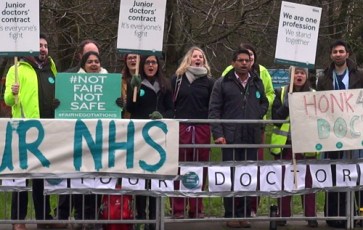
Junior doctors’ strike in Harrow setting

0

np2.Still001Northwick Park junior doctors played their active part in the national junior doctors’ strike on 12 January, following a powerful protest and rally in London to ‘Save NHS Bursaries’, both expressing bitterness about how badly the NHS has been treated by the governments.
Junior doctors are very important. It is a sect of society that is not normally militant, putting their dedication for their patient above anything else. They have not taken action for 40 years – if they are that angry now, it is because they are very badly treated” said a supporter Marie Lynam whose husband was treated at the Northwick Park hospital.
The junior doctors’ action came after talks between the British Medical Association (BMA) and the government failed to reach agreement on a proposed new contract for junior doctors.
The BMA, which is concerned about pay for weekend working, career progression and safeguards to protect doctors from being overworked, said the strike had sent a “clear message” to the government.

Is Harrow opposition good value for money?

The Tory group on the council claims that it is the ‘second largest Conservative opposition in London’ but it does not feel that way.
The performance of the group that enjoys over £250,000 public money in allowances per year, appears very weak under Cllr Hall’s leadership, considering what they ought to be doing but are not doing.
SH D3The opposition should work as a critical friend, assisting the administration whenever possible and suggesting healthy alternatives whenever necessary, all in the interest of effectively serving the community. But what happens is a kind of ‘punch and judy’ attitude by the opposition at the Council meetings or the Cabinet question times or through the letters in a local newspaper – all in a show of point scoring.
For example, they keep objecting major planning proposals, probably as this is the only area to stir because of the planning expertise of their planning portfolio holder in the pre2010 administration who otherwise has been kept at a distance since her come back to the council.
They have failed to suggest where the civic centre could be housed or where the much needed affordable homes could be built, instead they rubbish the council’s regeneration programme and have opposed the plans like for 318 new homes on the former post office site in College Road, Harrow.
No shadow budget has been presented thereby denying residents alternatives to the financial decisions being taken by the administration – one reason for this is because of the apparent lack* of budgeting experience and knowledge to lead meaningful debate on the Council finances.
* the budget presented by Cllr Hall during her short-lived Tory administration – a fluke – was badly defeated!

Public health is to crumble under ‘austerity measures’

Public health, under local government control, is in a position to consider the community assets, those who deliver and benefit from services, looking beyond needs and treatments.
However, the Harrow council, like other councils, faces huge challenge to deliver an effective public health service, given worst financial settlement for local government and a contracting budget.aus.Still001
For some, the compound effect of unemployment and welfare cuts means worse diets, colder homes and less physical mobility, with potentially longer-term health and welfare impacts. Add to this the weak aspects of the public health in Harrow, like mental health and the health inequality gap, and the picture becomes quite alarming.
Furthermore, the cabinet meeting on 10/12/12 approved the draft budget for 2016/17 and the Medium Term Financial Strategy (MTFS) 2016/17 to 2018/19 for general consultation that includes the proposal to cut down its public health budget from around £10.7m in 2015-16 to £5.9m by 2018-19.
The proposed cuts include a 60% cut to drug and alcohol services, nearly £700,000 for staff that support non-statutory services such as workplace health, long-term conditions and unemployment, 15% cuts in the sexual health service in 2017-18 and a 93% reduction in the smoking cessation services.

Austerity Demonstration in Harrow early this year

Council performance, a mixed picture

While the Harrow council seems to be doing well in the areas like economic growth and regeneration, Care Act, ensuring an efficient and effective organisation, it is not doing well for the vulnerable.
Kiran2A council performance report by the portfolio holder for performance Councillor Kiran Ramchandani (photo) before the cabinet meeting on 10 December, identifies a number of targets that have not recently been  met or where the performance in well below the target, despite the vulnerability specific council motions.
This failure suggests that although the council gathers various information about who benefits/ does not benefit from its services, effective use of the information to redress imbalances is not good enough.
Following are some of the areas where the targets have not recently been met:
• number of eligible people receiving health checks
• percentage of Mental Health clients in paid employment
• percentage of social care users with self-directed support taking up a cash payment
   option
• total number of households to whom the council has accepted a full homelessness
   duty
• first time entrants to Youth Justice System
• Child Protection Plan for 2nd or subsequent time (within two years of last plan)
• 16 to 18 year olds who are not in education, employment or training
• care leavers not in education, employment or training (19 – 21 year olds)
• termly rate of permanent exclusions of pupils as percentage of Harrow school
   population
• percentage of sessions absent from school amongst school age Children Looked
   After, in school year to date
• Children Looked After: rate of permanent exclusions as percentage of Harrow
   Children Looked After population
Also, the under-representation of black and minority ethnic (BAME) people at top level jobs as well as the proportion of disabled employees at the council remain an issue, made worst by the council not always testing the market for the senior posts.